
Last updated: 29 October 2026. The wording below is given in Arabic, transliteration, English and Urdu, with the source for each.
Quick answer: the niyat (niyyah) for Umrah is the decision in your heart to perform Umrah. At the miqat, after putting on Ihram, the Sunnah is to say “Labbayka Allahumma ‘umratan” (“Here I am, O Allah, for Umrah”) and then begin the Talbiyah. The popular Urdu-world wording, “Allahumma inni uridul-‘umrata fa yassirha li wa taqabbalha minni”, is a good dua but is not from a hadith, so saying it is optional.
In this guide
Umrah ki niyat: the exact words
The Sunnah wording: say it once, at the miqat
لَبَّيْكَ اللَّهُمَّ عُمْرَةً
Labbayka Allahumma ‘umratan.
“Here I am, O Allah, for Umrah.”
اے اللہ! میں عمرہ کے لیے حاضر ہوں۔
Source: the Prophet ﷺ named his rite aloud when entering Ihram (“Labbayka ‘umratan wa hajjan”, Sahih Muslim 1251); the Saudi Ministry of Hajj and Umrah’s Ihram guide uses this wording for Umrah. Grade: sahih.
The common formula (optional)
اللَّهُمَّ إِنِّي أُرِيدُ الْعُمْرَةَ فَيَسِّرْهَا لِي وَتَقَبَّلْهَا مِنِّي
Allahumma inni uridul-‘umrata fa yassirha li wa taqabbalha minni.
“O Allah, I intend to perform Umrah, so make it easy for me and accept it from me.”
اے اللہ! میں عمرہ کرنے کی نیت کرتا ہوں، پس اسے میرے لیے آسان فرما اور اسے میری طرف سے قبول فرما۔
Source: no hadith. This is a formula from the books of fiqh (al-Quduri in the Hanafi school; Ibn Qudamah’s al-Mughni). It is a good dua in meaning; saying it is optional. Women say karti hoon (کرتی ہوں) in Urdu.
Roman Urdu: “Ai Allah! Main Umrah karne ki niyat karta hoon, pas isay mere liye aasan farma aur isay meri taraf se qubool farma.”
Some Urdu books also give a simple line to say or think: “میں اللہ کی رضا کے لیے عمرہ ادا کرنے کی نیت کرتا ہوں” (“Main Allah ki raza ke liye Umrah ada karne ki niyat karta hoon”: “I intend to perform Umrah for the pleasure of Allah”). Any of these is fine as long as the intention is in your heart.
Is the niyat said aloud or in the heart?
All scholars agree the intention itself is in the heart: if you decided to perform Umrah and entered Ihram for it, your niyat is made, even if you never said it in words. What they differ on is whether to also say it:
| School | Position on saying the intention |
|---|---|
| Hanafi | Recommended to say it, to help the heart focus. Ihram also needs a statement or act with the intention, which the Talbiyah fulfils. |
| Shafi’i | Recommended to say it, to confirm what is in the heart (al-Nawawi). |
| Maliki | The intention in the heart is enough; the Talbiyah is a separate requirement. |
| Hanbali | The school’s books recommend it; Ibn Taymiyyah, Ibn Baz and Ibn Uthaymin held that saying it is not prescribed. |
What everyone accepts is the Talbiyah wording that names the rite, “Labbayka Allahumma ‘umratan”, because the Prophet ﷺ did it. So if you want one thing to say, say that. If your family follows the Hanafi or Shafi’i way and says the longer formula too, that is fine.
When and where to make the niyat
You make the niyat and start the Talbiyah at the miqat, the boundary you must not cross towards Makkah without Ihram if you are going for Umrah. The five miqats are:
| Miqat | Today known as | For pilgrims coming from |
|---|---|---|
| Dhul Hulayfah | Abyar Ali, near Madinah | Madinah (if you visit Madinah first) |
| Al-Juhfah | Near Rabigh | Egypt, Syria, North Africa and the north-west |
| Qarn al-Manazil | As-Sayl al-Kabir, near Taif | Riyadh, the Gulf and the east |
| Yalamlam | As-Sa’diyyah | Yemen and the south |
| Dhat Irq | Near Dariba | Iraq and the north-east |
On a plane: the crew usually announce when you are about to cross the miqat. Put on your Ihram clothes before boarding or on the plane, and make the niyat and start the Talbiyah at the announcement. Don’t wait until you land in Jeddah, which is inside the miqat for those flying in. Our Jeddah airport to Makkah guide explains this, along with the options for getting to the Haram.
If you are already in Makkah (for example, for a second Umrah), go outside the Haram boundary, usually to Masjid Aisha at Tan’im, to make the niyat.
Step by step: from bath to Talbiyah
- Ghusl: take a bath before Ihram (recommended), trim nails and remove unwanted hair if needed.
- Perfume (men): perfume the body, not the Ihram clothes, before the intention.
- Ihram clothes: men wear two plain white unstitched sheets; women wear ordinary modest clothes, without a face veil (niqab) or gloves.
- Prayer: if it is the time of an obligatory prayer, pray it and enter Ihram after it. Most scholars also recommend two voluntary rak’ahs before Ihram (many recite Surah al-Kafirun and al-Ikhlas); others say there is no prayer specific to Ihram. Either way, don’t pray in the times when voluntary prayer is disliked.
- Niyat: intend Umrah in your heart and say “Labbayka Allahumma ‘umratan”. Add the optional formula if you wish.
- Condition: if you fear illness or another obstacle, add the condition (below).
- Talbiyah: begin the Talbiyah and keep saying it until you start Tawaf.
The Talbiyah: from the miqat until you start Tawaf
لَبَّيْكَ اللَّهُمَّ لَبَّيْكَ، لَبَّيْكَ لَا شَرِيكَ لَكَ لَبَّيْكَ، إِنَّ الْحَمْدَ وَالنِّعْمَةَ لَكَ وَالْمُلْكَ، لَا شَرِيكَ لَكَ
Labbayka Allahumma labbayk. Labbayka la sharika laka labbayk. Innal-hamda wan-ni’mata laka wal-mulk. La sharika lak.
“Here I am, O Allah, here I am. Here I am, You have no partner, here I am. All praise and blessings are Yours, and the dominion. You have no partner.”
میں حاضر ہوں، اے اللہ! میں حاضر ہوں۔ میں حاضر ہوں، تیرا کوئی شریک نہیں، میں حاضر ہوں۔ بے شک ہر تعریف اور ہر نعمت تیری ہے اور بادشاہی بھی، تیرا کوئی شریک نہیں۔
Source: Sahih al-Bukhari 1549; Sahih Muslim 1184. Grade: sahih. Men say it aloud; women say it so that they can hear themselves.
Adding a condition (ishtirat)
If you are worried that illness, a flight cancellation or something else might stop you from completing Umrah, the Sunnah allows you to add a condition when making your niyat. Then, if you are stopped, you can leave Ihram without any penalty.
The condition (ishtirat), only if you fear an obstacle
فَإِنْ حَبَسَنِي حَابِسٌ فَمَحِلِّي حَيْثُ حَبَسْتَنِي
Fa in habasani habisun fa mahilli haythu habastani.
“If anything prevents me, then my place of leaving Ihram is wherever You prevent me.”
اگر کوئی رکاوٹ مجھے روک دے تو میرے احرام کھولنے کی جگہ وہی ہے جہاں تو مجھے روک دے۔
Source: this longer wording is from the Saudi Ministry of Hajj and Umrah’s Ihram guide. The hadith wording is the short form, “Allahumma mahilli haythu habastani”, which the Prophet ﷺ taught Duba’a bint al-Zubayr when she was ill (Sahih al-Bukhari 5089; Sahih Muslim 1207). Grade: sahih.
The short form from the hadith is “Allahumma mahilli haythu habastani” (“O Allah, my place of leaving Ihram is wherever You stop me”). Scholars who accept it advise adding it only when there is a real reason to fear an obstacle.
Note for Hanafi and Maliki readers: making this condition is the position of the Shafi’i and Hanbali schools. The Hanafi and Maliki schools do not give it this effect, so in those schools a pilgrim who is prevented follows the normal rules for someone held back (including a sacrifice). Ask your own scholar if you are relying on the condition.
Niyat for special cases
Umrah on behalf of someone else (Umrah-e-Badal)
You can perform Umrah for a parent or relative who has died or cannot travel. Name the person in your Talbiyah: “Labbayka ‘umratan ‘an [name]” (“Here I am for Umrah on behalf of…”). This follows the hadith of the man who said “Labbayka ‘an Shubrumah” (Abu Dawud 1811, sahih), which was about Hajj; scholars apply it to Umrah too. The Shafi’i and Hanbali schools require you to have done your own Umrah first; the Hanafi school considers it valid but disliked if you haven’t, so doing your own first is best.
Children
A child’s Umrah is valid. A parent or guardian makes the intention for a young child who can’t understand, and the child is dressed in Ihram. See Umrah with children.
Women during their period
A woman who is menstruating, or bleeding after childbirth, still takes a bath, puts on her Ihram clothes and makes the niyat at the miqat. She does everything except Tawaf, and waits until she is pure to perform it. In Sahih Muslim 1218, the Prophet ﷺ told Asma bint Umays, who had just given birth, to bathe and enter Ihram.
A second Umrah from Makkah
Go outside the Haram boundary, usually Masjid Aisha at Tan’im, and make the niyat there, just as you did the first time.
Mistakes to avoid
- Crossing the miqat without the niyat. If you do, go back to a miqat and enter Ihram there; otherwise most scholars say you must offer a sacrifice (dam) in Makkah.
- Thinking the Ihram clothes are the niyat. Putting on the sheets in Pakistan or India before the flight is fine, but you are not in Ihram until you make the intention.
- Thinking the words must be in Arabic. The intention is in the heart; any language is fine.
- Stopping the Talbiyah too early or too late. For Umrah, keep saying it until you begin Tawaf.
- Applying perfume after the niyat. Perfume is only allowed before you enter Ihram.
Once you are in Ihram, certain things become forbidden until you finish Umrah. See our Ihram rules guide for the full list.
Free printable Ihram card
A one-page card with the niyat, the condition and the Talbiyah, in Arabic, transliteration, English and Urdu. Keep it in your hand luggage or save the image to your phone.
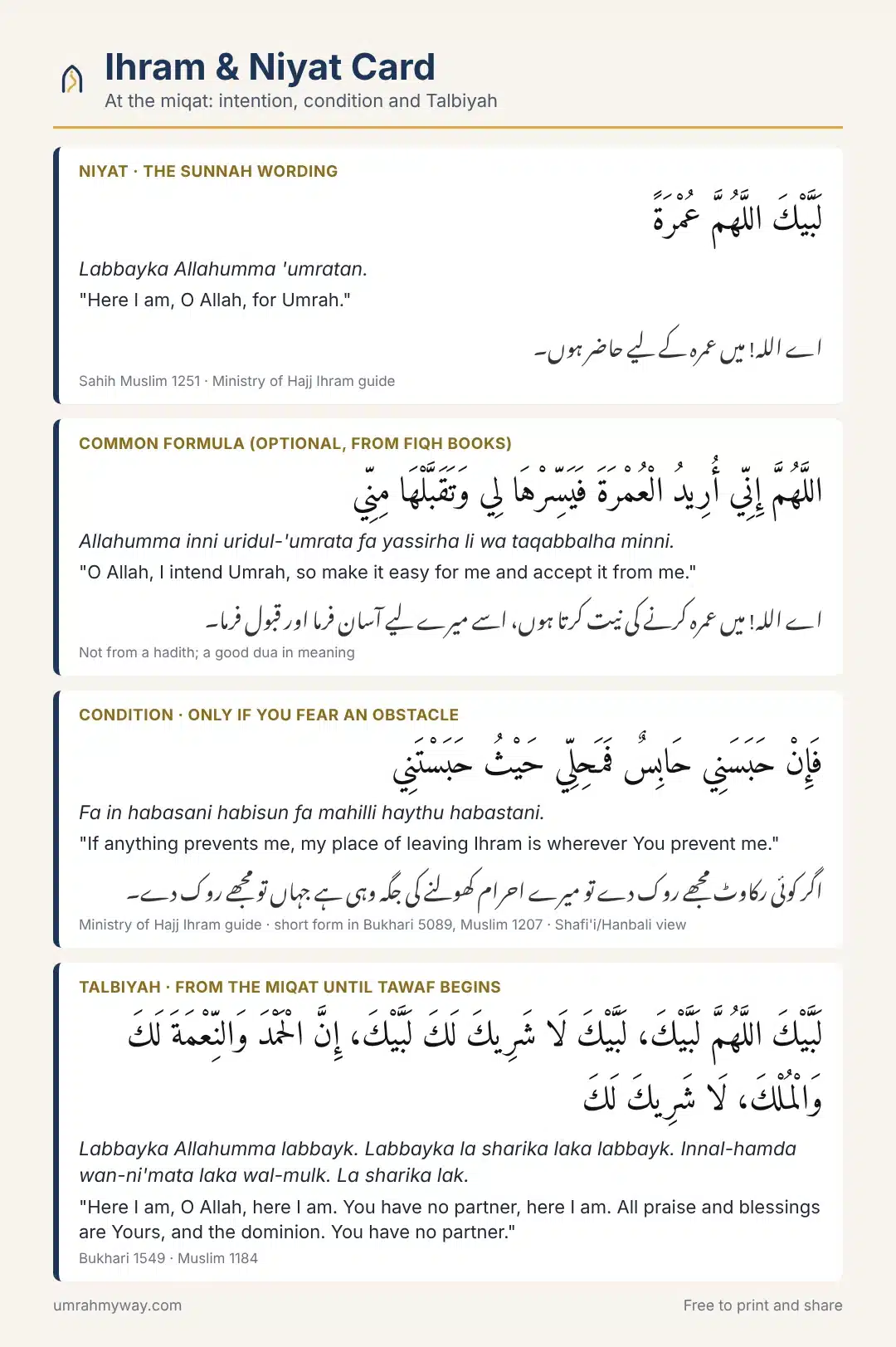
Download the printable PDF Save the image for your phone
Frequently asked questions
What is the niyat for Umrah?
The intention in your heart to perform Umrah for Allah. At the miqat, the Sunnah is to say “Labbayka Allahumma ‘umratan” and then begin the Talbiyah.
What is the dua for Umrah ki niyat?
The common one is “Allahumma inni uridul-‘umrata fa yassirha li wa taqabbalha minni” (“O Allah, I intend Umrah, so make it easy for me and accept it from me”). It is not from a hadith, but it is a good dua and you may say it.
How do I make the niyat to go on Umrah?
After putting on Ihram, at or before the miqat, decide in your heart to perform Umrah, say “Labbayka Allahumma ‘umratan”, and start the Talbiyah.
How do I pray the 2 rak’ah nafl before Umrah?
Pray two rak’ahs like any voluntary prayer, often with Surah al-Kafirun and Surah al-Ikhlas, after your bath and before the niyat, unless it is a time when voluntary prayer is disliked. Some scholars say there is no prayer specific to Ihram, so you can also enter Ihram after an obligatory prayer.
Does the niyat have to be in Arabic?
No. The intention is in your heart, in any language. The short Sunnah phrase is easy to learn in Arabic, though.
Can I make the niyat before reaching the miqat?
Yes, at or before the miqat. On a plane, many people enter Ihram a little early so they don’t miss the announcement.
What is the difference between the niyat for Hajj and Umrah?
For Umrah you say “Labbayka Allahumma ‘umratan”; for Hajj, “Labbayka Allahumma hajjan”. For Hajj Tamattu’, you first enter Ihram for Umrah and later for Hajj.
What happens if I forget to make the niyat at the miqat?
Go back to a miqat and enter Ihram there if you can. If you enter Ihram after passing it, most scholars say a sacrifice (dam) is due in Makkah.
Sources
- Sahih Muslim 1251
- Sahih al-Bukhari 1549: the Talbiyah
- Sahih al-Bukhari 5089: the condition (ishtirat)
- Sahih Muslim 1218
- Sunan Abi Dawud 1811: on behalf of Shubrumah
- Ministry of Hajj and Umrah: Ihram guide
- Dar al-Ifta al-Misriyyah 19267: saying the intention
- IslamQA 31821
- IslamQA 109241: when to add the condition