A clear, calm guide to every ritual — what to do, what to say, and what to expect
If you’re preparing for Umrah and feeling overwhelmed by all the information out there — you’re not alone. Most guides are either too technical or too brief. This one aims to be different: clear, calm, and practical.
Umrah consists of four main rituals. The entire act of worship typically takes 3–6 hours depending on crowd levels. This guide walks you through each step in plain language, including what to say, what to watch out for, and what to expect on the day.
What is Umrah?
Umrah is the lesser pilgrimage to Masjid al-Haram in Makkah — a sacred act of worship that Muslims can perform at any time of year except during the Hajj season. Unlike Hajj (which is obligatory once in a lifetime for those who are able), Umrah is a voluntary act of immense reward.
The Prophet ﷺ said: “Umrah to Umrah expiates the sins committed between them.” (Bukhari & Muslim)
Umrah consists of four pillars:
- Ihram (entering the sacred state)
- Tawaf (circling the Kaaba seven times)
- Sa’i (walking between Safa and Marwah seven times)
- Halq or Taqsir (shaving or trimming the hair to exit Ihram)
Before you leave for the Haram: preparation
At your hotel (before entering Ihram):
Take a full Ghusl (ritual bath). This is Sunnah and strongly recommended before entering Ihram. Trim your nails. Remove excess body hair (underarms and below the navel). These are part of the Sunnah preparation.
Men: After Ghusl, you may apply perfume to your body — but not to the Ihram cloth itself. This is the last time you can use perfume until Ihram ends. Put on the two unstitched white cloths (Izar for the lower body, Rida for the upper body).
Women: Wear your regular modest Islamic dress. Any colour is permissible. There is no specific Ihram garment for women. Do not apply perfume to your clothes.
Perform two rak’ahs of Sunnah prayer at your hotel before leaving for the Miqat or the Haram, facing the Qibla.
Step 1: Ihram — entering the sacred state
For those traveling by plane
International flights into Jeddah (JED) or Madinah (MED) pass over the Miqat boundaries. The airline typically announces when you’re approaching. Have your Ihram clothes ready and change before crossing.
Many pilgrims put on their Ihram before boarding to avoid the rush of changing on the plane. If you’re flying into Madinah first (recommended), you don’t need to be in Ihram on the plane — you enter Ihram when you’re ready to travel from Madinah to Makkah.
For those traveling by bus from Madinah (like we did)
If you stay in Madinah first and then travel to Makkah by SAPTCO bus or train, the Miqat for travelers coming from Madinah is Dhul Hulayfah (also called Abyar Ali). This is just outside Madinah city.
You must be in Ihram before the bus passes the Miqat. The bus does not stop there. Put on your Ihram at your Madinah hotel and make your Niyyah before leaving. You can also pray two rak’ahs and make Niyyah at Masjid Dhul Hulayfah (which has facilities for this purpose) on your way to the bus station.
Making the Niyyah (intention)
Face the Qibla and make your intention:
“Labbayk Allahumma bi Umrah” (O Allah, I respond to Your call to perform Umrah)
Or in your own language from your heart — the intention is in the heart.
Reciting the Talbiyah
After making your Niyyah, begin reciting the Talbiyah:
“Labbayk Allahumma Labbayk. Labbayk la shareeka laka Labbayk. Innal-hamda wan-ni’mata laka wal-mulk. La shareeka lak.”
Translation: “Here I am, O Allah, here I am. Here I am, You have no partner, here I am. Verily all praise, grace and sovereignty belong to You. You have no partner.”
Men recite this aloud. Women recite softly.
Keep reciting the Talbiyah continuously from this point — on the bus, walking to the mosque, all the way until you begin Tawaf. Stop the Talbiyah when you begin Tawaf.
Ihram restrictions
Once in Ihram, the following become prohibited until you complete Umrah and perform Halq/Taqsir:
- Using perfume or scented products (including scented soap — use unscented)
- Cutting or removing hair (including shaving, waxing, plucking eyebrows)
- Cutting nails
- For men: covering the head, wearing stitched clothing, wearing socks or shoes that cover the ankle
- Marital relations and any sexual activity
- Hunting or harming animals
- Arguing, using foul language, or behaving inappropriately
These restrictions focus your mind. They strip away comfort deliberately — you’re a guest at Allah’s House, and this is the dress code for that visit.
Step 2: Tawaf — circling the Kaaba seven times
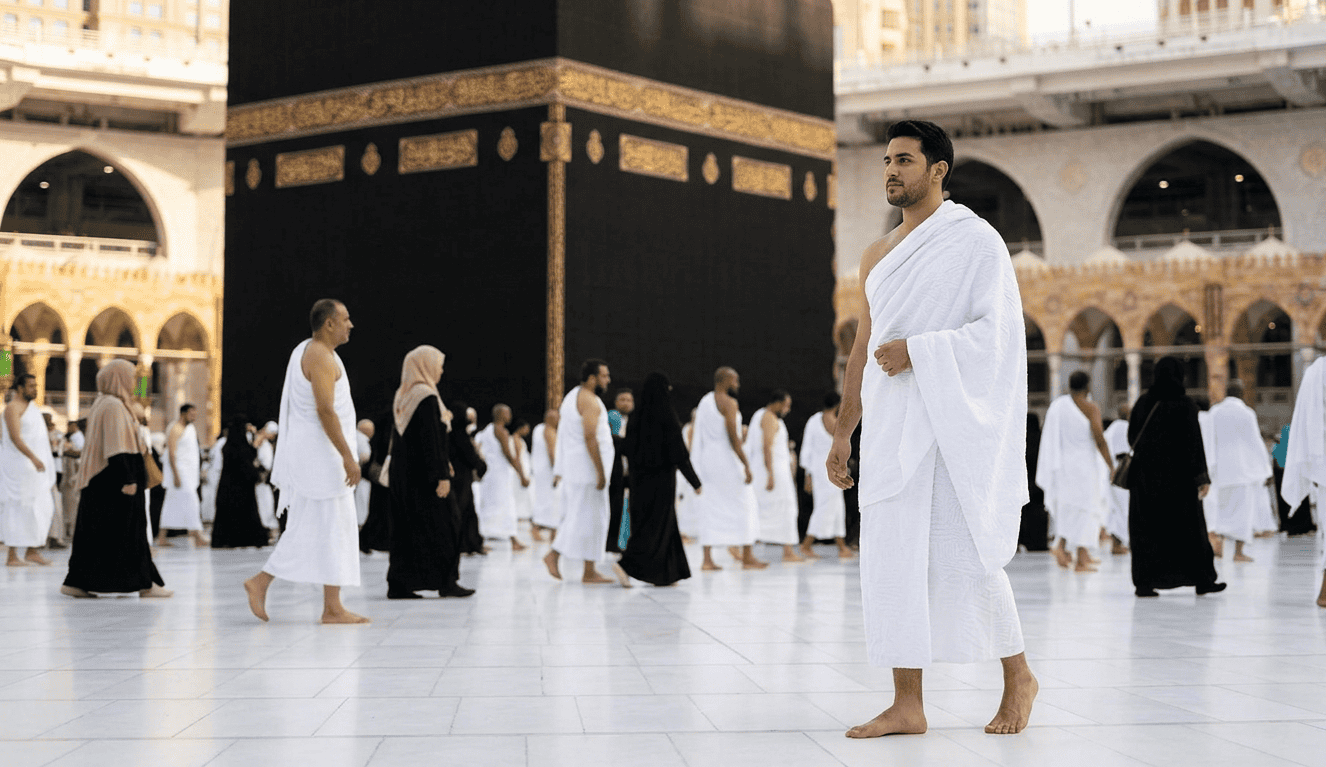
Tawaf means circling the Kaaba (the black cube at the centre of Masjid al-Haram) seven times in an anti-clockwise direction.
Before you begin
Make sure you are in a state of Wudhu (ablution). Tawaf is invalid without wudhu — if yours breaks during Tawaf, leave the Mataf area, renew wudhu, and return to complete your circuits.
Men: Perform Idtiba — uncover your right shoulder by passing the upper Ihram cloth (Rida) under your right arm so it drapes over your left shoulder only. Do this before Tawaf and keep it throughout all seven circuits.
Finding the starting point
Look for the Black Stone (Hajar al-Aswad) at the eastern corner of the Kaaba. This is where each circuit begins and ends. On the floor of the Mataf (the circling area), there is a green light on the wall of the mosque opposite the Kaaba indicating the starting line.
The Black Stone: If you can reach it, touch or kiss it (as the Prophet ﷺ did) while saying “Bismillah Allahu Akbar.” If the crowd makes this impossible — which it usually is — simply face it, raise your right hand as if gesturing toward it, and say “Allahu Akbar.” Do not push or harm anyone to reach it. Allah knows your intention.
Performing the seven circuits
Walk anti-clockwise around the Kaaba, keeping the Kaaba on your left side. Complete seven full circuits. Each time you pass the starting point, raise your hand (or gesture) toward the Black Stone and say “Allahu Akbar.”
During the circuits:
- There is no specific dua required — recite whatever you know, make personal prayers in your own language, or recite Salawat on the Prophet ﷺ
- Pray from your heart. This is your time with Allah.
- Men should walk briskly (Raml) during the first three circuits — short, energetic steps. The remaining four are at a normal pace.
- Women walk at a normal pace throughout
- If you feel overwhelmed — tears, emotion, speechlessness — that’s completely normal. Let it come.
After Tawaf
When you complete seven circuits, go toward Maqam Ibrahim — the glass enclosure near the Kaaba containing the stone on which Ibrahim (AS) stood while building the Kaaba. Pray two rak’ahs of Salah here. If the crowd makes standing near Maqam Ibrahim impossible, pray anywhere in the mosque.
After the prayer, go to drink Zamzam water — water from the blessed well within the Haram. Drink it while standing, facing the Qibla, and making dua.
Step 3: Sa’i — walking between Safa and Marwah
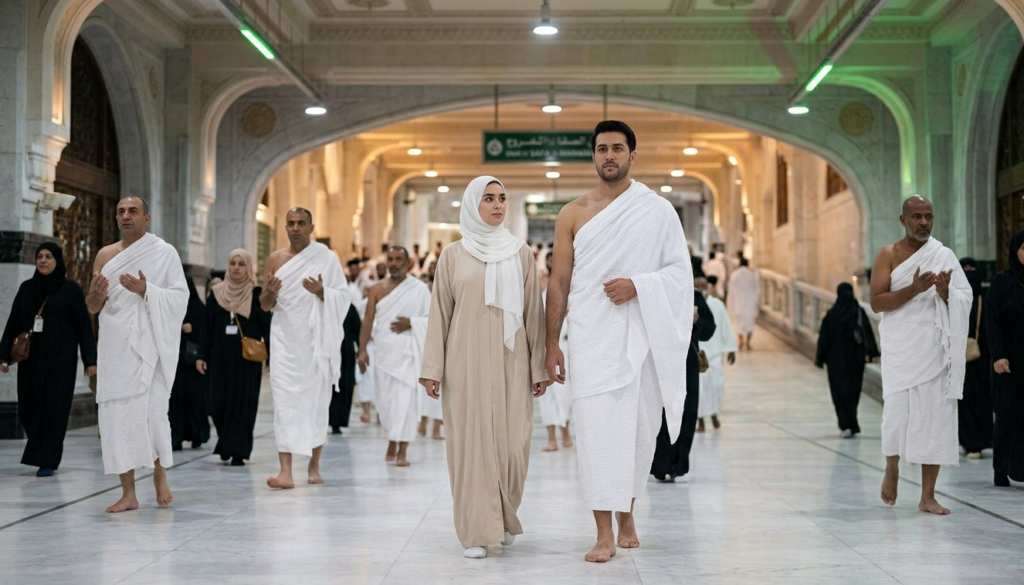
Sa’i commemorates the struggle of Hajar (AS), the wife of Prophet Ibrahim, who ran desperately between the hills of Safa and Marwah searching for water for her infant son Ismail. Allah loved her faith and determination so much that He made this act a pillar of Umrah.
How to perform Sa’i
- Walk from the Tawaf area toward the Safa hill — you’ll see signs directing you
- As you approach Safa, recite: “Inna Assafa wal Marwata min sha’airillah” (Indeed Safa and Marwah are among the Signs of Allah) — recite this only before your first lap
- Climb Safa, face the Kaaba, raise your hands, and make dua. Say “Allahu Akbar” three times.
- Walk toward Marwah — this is your first lap
- Between the green markers: Men walk quickly (this section commemorates Hajar’s running). Women walk at a normal pace throughout.
- At Marwah, face the Kaaba, raise your hands, and make dua
- Walk back toward Safa — this is your second lap
- Continue until you complete seven laps. You START at Safa (lap 1) and END at Marwah (lap 7).
Counting laps: Safa to Marwah = 1 lap. Marwah to Safa = 2 laps. And so on. Seven laps end at Marwah.
During Sa’i: There are no fixed duas required. Make your personal prayers, recite Quran, or ask Allah for whatever is in your heart. Sa’i is a time of intense dua.
Wudhu is recommended for Sa’i but not strictly required (scholars differ on this — to be safe, maintain wudhu throughout).
Step 4: Halq or Taqsir — exiting Ihram
This is the final step that ends your Umrah and releases you from Ihram.
Halq (for men): Shaving the entire head. This is preferred and more virtuous. Barber shops are everywhere near the Haram — they charge SAR 10–30 and are experienced with pilgrims. Many shave immediately after completing Sa’i inside the Haram complex.
Taqsir (for men who choose not to shave): Cutting the hair shorter by at least a fingertip’s length from all over the head. Not just the ends — the hair must be shortened all around.
For women: Only Taqsir — cutting approximately 1–2 cm from the ends of the hair. Women do not shave their heads. This can be done privately in the hotel room or bathroom.
Once Halq or Taqsir is complete, your Umrah is finished. All Ihram restrictions are lifted. You can put on regular clothes, use perfume, and return to normal activities.
Alhamdulillah — your Umrah is accepted, inshAllah.
How long does Umrah take?
- During quiet periods: 3–4 hours
- During moderate crowds: 4–6 hours
- During Ramadan or Fridays: 6–10 hours (Tawaf and Sa’i become very crowded)
Best times to perform Umrah for less crowding:
- Late night after Isha (midnight to Fajr) — this is actually when many experienced pilgrims prefer to go
- Early morning after Fajr
- Midday during weekdays (though the heat is intense in summer)
Avoid: Fridays (Jummah day), the days of Eid, and peak Ramadan nights.
Performing Umrah on behalf of someone else
Yes, you can perform Umrah on behalf of a deceased person or someone physically unable to travel. When making your Niyyah, say:
“Labbayk Allahumma Umratan an [name of the person]”
The reward goes to them, inshAllah. Complete scholars say you should perform your own Umrah first before performing it on behalf of others.
Common mistakes to avoid
Not being in Wudhu for Tawaf: If your wudhu breaks before completing four circuits, restart from the beginning. After four circuits, many scholars allow continuing after renewing wudhu — consult a scholar for your situation.
Losing count of circuits: Carry a small tasbeeh counter. Count each completed circuit — seven circuits completed at the Hajar al-Aswad corner.
Not maintaining the correct direction: Always keep the Kaaba on your LEFT side. Anti-clockwise only.
Rushing and pushing during Tawaf: This is worship, not a race. Patience and gentleness are part of performing Umrah correctly.
Forgetting to stop Talbiyah when Tawaf begins: The Talbiyah ends when you begin your first circuit of Tawaf.
Starting Sa’i before praying two rak’ahs after Tawaf: Pray the two rak’ahs at Maqam Ibrahim before beginning Sa’i.
Performing Sa’i without having completed Tawaf: Tawaf must come first.
After Umrah
Take a moment to sit in the Haram after completing your Umrah. Make extended dua — the doors of acceptance are wide open. Drink more Zamzam water. Offer optional (Nafl) prayers.
If you wish to perform a second Umrah during your stay, you must leave the boundaries of the Haram, re-enter Ihram, and return. Masjid Aisha (also called Masjid Tan’im), about 5–7 km from the Haram, is the most commonly used location for this. A taxi or Careem will take you there and back for SAR 20–40.
May Allah accept your Umrah, forgive your sins, and shower you with His infinite mercy. Ameen.
Related articles:
- → How I Self-Booked Umrah for My Family — Complete Guide
- → Nusuk App Guide — How to Book Rawdah Permit & Umrah Permit
- → Umrah Packing List — Complete Checklist 2026
- → Self-Booked Umrah vs Package Tour — Honest Comparison
Disclaimer: This guide provides general guidance on Umrah rituals. For specific religious rulings and scholarly questions, always consult a qualified Islamic scholar. Rituals should be performed according to your madhab (school of thought). This is a personal travel blog, not a fatwa or religious authority.
7 thoughts on “How to Perform Umrah Step by Step — Complete Guide for First-Timers (2026)”