Last updated: May 2026 | Based on our February 2023 Umrah experience
The moment you declare your Niyyah and cross the Miqat boundary, ordinary life pauses. Every restriction begins. Every action matters.
I remember standing in the aircraft bathroom as we approached Saudi Arabia, carefully wrapping the Ihram sheets and making sure everything was correct. I had read guides online, but nothing quite prepares you for the responsibility of that moment — knowing that from here, every action must follow specific rules until your Umrah is complete.
This guide covers everything you need to know about Ihram rules before you travel — what to wear, what is strictly forbidden, and the seven most common mistakes pilgrims make (and exactly how to avoid them).
What Is the State of Ihram?
Ihram is both a physical state and a spiritual one. The word itself means “to make something forbidden” — and that is precisely what happens when you enter it. Certain actions that are normally permissible in daily life become forbidden once you cross the Miqat in a state of consecration.
The state of Ihram does not simply mean wearing white clothing. It is a complete condition of the pilgrim that begins with intention and ends only after completing the full sequence of Umrah rituals.
Ihram begins: When you make your intention (Niyyah) and recite the Talbiyah at or before the Miqat boundary.
Ihram ends: Only after completing Tawaf (7 circuits of the Kaaba) → Sa’i (7 lengths between Safa and Marwah) → Halq or Taqsir (shaving or cutting hair). This sequence is non-negotiable. Cutting your hair before completing Sa’i does not end your Ihram.
The Five Miqat Boundary Points
The Miqat is the designated boundary that pilgrims must not cross without being in Ihram. There are five Miqat points, and which one applies to you depends on where you are travelling from.
For pilgrims flying from India, Pakistan, Bangladesh, and most of Asia: Your flight will typically pass over Dhul Hulayfah (also called Abar Ali), near Madinah, or Yalamlam (south of Makkah). The aircraft captain will announce when you are approaching the Miqat — usually 20 to 30 minutes before crossing.
The safest approach for air travellers: Put on your Ihram before you board the aircraft at your home country airport. Make your Niyyah and begin the Talbiyah before the aircraft crosses the boundary. This removes all risk of missing the Miqat.
For pilgrims already in Madinah (as we were — flying into Madinah first): You make your Ihram at Masjid Dhul Hulayfah (also called Masjid Meeqat or Abar Ali) before leaving Madinah for Makkah. This is what we did — we went to the mosque, changed into Ihram, made our Niyyah, and then boarded the SAPTCO bus to Makkah.
Ihram for Men — Exactly What to Wear
The Two Garments
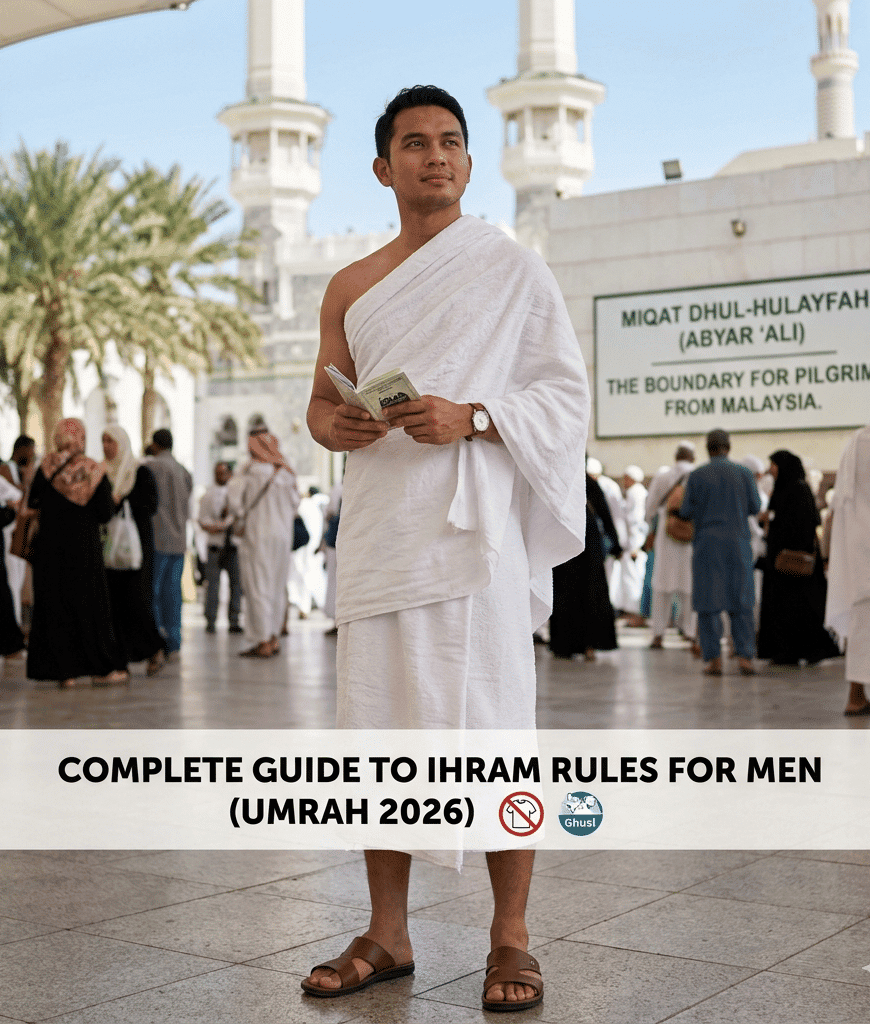
Male pilgrims must wear two specific pieces of unstitched white cloth:
1. Izar (lower garment): Wraps around the waist and covers the lower body from the waist to below the knees. Think of it like a large white towel wrapped around your waist.
2. Rida (upper garment): Drapes over the left shoulder and covers the upper body. The right shoulder is left exposed during Tawaf (this is called Idtibaa — a Sunnah act for men).
Both garments must be plain white and completely unstitched — no sewn seams, no pockets, no buttons. Pre-made Ihram sets available in shops are specifically designed to meet these requirements.
Before you travel: Buy your Ihram set in India before you leave — it is much cheaper than buying it in Saudi Arabia. Sets range from ₹300 to ₹800 and are available in any Islamic clothing shop. Buy two sets — the first will likely become damp with sweat during Tawaf.
Footwear for Men
Men’s footwear must expose both the ankles and the top ridge (dorsum) of the foot. Simple flat sandals are ideal. Heavy athletic sneakers or shoes that cover the top of the foot are not permitted.
Our tip: We wore simple rubber sandals throughout. They were comfortable for Tawaf and Sa’i, easy to remove at mosque entrances, and cost under ₹200 in Bangalore.
The Stitching Rule for Men
This is the most commonly misunderstood rule: all stitched clothing is forbidden for men during Ihram. This includes:
- Regular underwear or briefs beneath the Ihram sheets
- T-shirts worn under the Rida
- Socks
- Belts with stitching (use an unstitched Ihram belt instead)
Many first-time pilgrims wear their normal underwear beneath the Ihram sheets. This is a violation that requires kaffarah (expiation). Remove all stitched undergarments before putting on Ihram.
Ihram for Women — What to Wear
Women have significantly more flexibility in their Ihram clothing. There is no specific garment required — women wear their normal modest clothing.
What women wear:
- Loose, modest clothing covering the full body (a full-length abaya with hijab is perfect)
- Any colour is permitted — white is not required
- Normal modest shoes or sandals (no footwear restriction for women)
What women must NOT wear during Ihram:
- A tight-fitting niqab or face veil clipped close to the face (the face must remain fully uncovered)
- Tight-fitting gloves (hands must remain uncovered)
A loose scarf or covering placed lightly over the face when near men (without clipping or tying it to the face) is permitted according to most scholars.
What Is Strictly Forbidden During Ihram
These prohibitions apply to both men and women from the moment Ihram begins until it ends:
1. Cutting or Trimming Hair or Nails
No hair may be cut from anywhere on the body. No nails may be trimmed. This includes eyebrow shaping, threading, or waxing.
Preparation: Trim your nails and cut any hair before entering Ihram. Do this as part of the Ghusl (ritual bath) that precedes Ihram.
2. Using Scented Products
No perfume, scented soap, scented shampoo, scented deodorant, scented lotion, or any fragrant product may be used. This includes:
- Your hotel room soap (almost certainly scented — bring your own)
- Scented wet wipes
- Scented lip balm
- Scented sunscreen
What to do: Purchase an unscented Hajj soap kit before leaving India. These are available in Islamic shops and on Amazon specifically for pilgrims.
3. Sexual Relations
All sexual relations are completely forbidden during Ihram.
4. Marriage or Proposing Marriage
No marriage contract may be performed or witnessed. No proposals may be made.
5. Hunting or Harming Animals
No animal may be hunted or harmed during Ihram. Even killing insects is a matter of scholarly difference — approach with caution.
6. Removing the Ihram Garments (Men)
Men may not remove their Ihram garments until Ihram ends, except for unavoidable necessity.
Additional Prohibitions for Men Only
7. Covering the Head
Men may not cover their heads with anything that rests on the head — no cap, hat, hood, or turban. If it is raining, an umbrella is permitted as long as it is held, not resting on the head.
Watch out for this on aircraft: It is easy to reflexively pull a blanket over your head while sleeping. This is a violation if it rests on your head. Some pilgrims tie a reminder string on their wrist.
8. Wearing Stitched Garments
As covered above — no stitched clothing at all. The Ihram sheets are the only garment.
9. Covered Ankles or Foot Tops (Footwear)
Shoes must not cover the ankles or the dorsum (top ridge) of the foot.
The 7 Most Common Ihram Mistakes — And How to Avoid Them
Mistake 1: Passing the Miqat Without Entering Ihram
What happens: The aircraft crosses the Miqat boundary while the pilgrim is sleeping or unaware, and they arrive in Saudi Arabia without having entered Ihram.
Consequence: A dam (penalty sacrifice — one sheep) is required. The pilgrim must return to the Miqat to enter Ihram properly, which is difficult from inside Saudi Arabia.
How to avoid it: Put your Ihram on before boarding the aircraft. Do not wait for the in-flight announcement — it may come at a moment when you cannot reach the bathroom.
Mistake 2: Using Scented Soap or Shampoo
What happens: The pilgrim uses the hotel bathroom soap or shampoo without realising it is scented. Both are almost always scented.
Consequence: Intentional use of scented products after Ihram begins requires kaffarah.
How to avoid it: Pack your own unscented soap and shampoo in your hand luggage. Do not touch the hotel soap until Ihram ends.
Mistake 3: Men Wearing Stitched Undergarments Under the Ihram Sheets
What happens: The pilgrim puts on their Ihram sheets but forgets to remove their regular underwear first.
Consequence: Wearing stitched clothing beneath the Ihram is a violation.
How to avoid it: Make removing stitched undergarments part of your Ihram preparation checklist. Do it before putting on the Ihram sheets — not after.
Mistake 4: Men Accidentally Covering Their Head
What happens: During a cold aircraft flight or while resting at the hotel, the pilgrim pulls a blanket or towel over their head without thinking.
Consequence: Covering the head intentionally requires kaffarah.
How to avoid it: If travelling by aircraft in Ihram, inform your travelling companions to remind you. Place your Rida (upper Ihram sheet) in a way that reminds you of the restriction.
Mistake 5: Losing Count of Tawaf Circuits
What happens: The dense crowds inside Masjid al-Haram cause disorientation, and the pilgrim loses track of whether they are on circuit 4 or 5.
What to do: Default always to the LOWER number you are certain of. If you are sure you completed at least 4 circuits, count from 4 onwards. Do not assume the higher number.
How to avoid it: Use a physical counter (tasbeeh counter or a manual tally counter clipped to your Ihram) to track each circuit as you complete it. A simple click counter from Amazon costs under ₹150 and solves this completely.
Mistake 6: Cutting Hair Before Completing Sa’i
What happens: The pilgrim completes Tawaf and goes for Halq (shaving) or Taqsir (hair cutting) before realising they have not yet completed Sa’i.
Consequence: Halq or Taqsir before Sa’i is a violation of the Umrah sequence. Ihram does not end until Sa’i is also complete.
How to avoid it: Memorise the sequence: Ihram → Tawaf → Sa’i → Halq/Taqsir. This order is fixed. Nothing ends your Ihram until all three steps are complete in this sequence.
Mistake 7: Physical Overexertion Before Performing Rituals
What happens: Pilgrims arrive after long flights, go directly to the Haram without rest, and then find themselves struggling through Tawaf while dehydrated and exhausted. Mistakes increase dramatically with fatigue.
What to do: When we arrived in Madinah after a long flight from Bangalore, we checked in, ate, rested for several hours, and then went to Masjid an-Nabawi for the first time. We performed Umrah only after settling into Makkah the following day.
The wisdom in this: Your Umrah deserves your full presence and concentration. A few hours of rest makes every step of the ritual more meaningful.
What Happens If You Break an Ihram Rule?
This is the question that creates the most anxiety — and the most important thing to know is that most violations have clear remedies. Allah is Most Merciful, and the rules of kaffarah exist precisely because scholars understood that mistakes happen.
Minor violations (like accidentally using scented soap once, or briefly covering the head) require fidya, which takes one of three forms:
- Feed six poor people (approximately half a saa’ of food each)
- Fast for three days
- Sacrifice one sheep
The most important thing: If you are unsure whether a violation occurred or which category it falls into, consult a scholar before or after your Umrah. Do not let anxiety ruin the spiritual experience. The scholars of Islam have addressed every possible scenario — there is always a remedy.
Pre-Miqat Checklist — Complete This Before Crossing
Use this checklist before you enter Ihram:
- Performed Ghusl (ritual bath)
- Trimmed nails and body hair (must be done BEFORE entering Ihram)
- Switched to unscented soap, shampoo, deodorant in your bag
- Put on Ihram garments correctly (for men: Izar and Rida, no stitched undergarments)
- Stated intention (Niyyah): “Labbayk Allahumma Umrah”
- Began reciting Talbiyah: Labbayk Allahumma Labbayk…
- Saved Nusuk app QR code permit screenshot (offline — no signal at Haram)
- Tasbeeh counter packed for Tawaf
- Unscented soap in hand luggage
- Water bottle for hydration during Tawaf
Packing Checklist for Ihram Specifically
Items to buy before you travel:
- Ihram set (men): Buy two sets — one will get damp during Tawaf
- Ihram belt (unstitched): Keeps the sheets secure during Tawaf
- Unscented soap and shampoo: Do not rely on hotel soap
- Simple sandals (men): Flat, open-toed, exposing ankles and top of foot
- Tally counter/tasbeeh: For counting Tawaf circuits without losing track
Related Articles
- How to Perform Umrah Step by Step — Complete Guide for First-Timers
- Complete Umrah Packing List 2026 — What to Actually Bring
- Nusuk App Complete Guide 2026 — How to Book Your Rawdah Permit
- How I Self-Booked Umrah for My Family — Complete Guide with Real Costs
May Allah make your Umrah easy and accepted. Ameen. 🤲
Have a question about Ihram rules? Leave a comment below and I will do my best to help.
1 thought on “Ihram Rules — Complete Guide for Men and Women (Do Not Skip This)”