Last updated: June 2026 | Based on our February 2023 Umrah visit
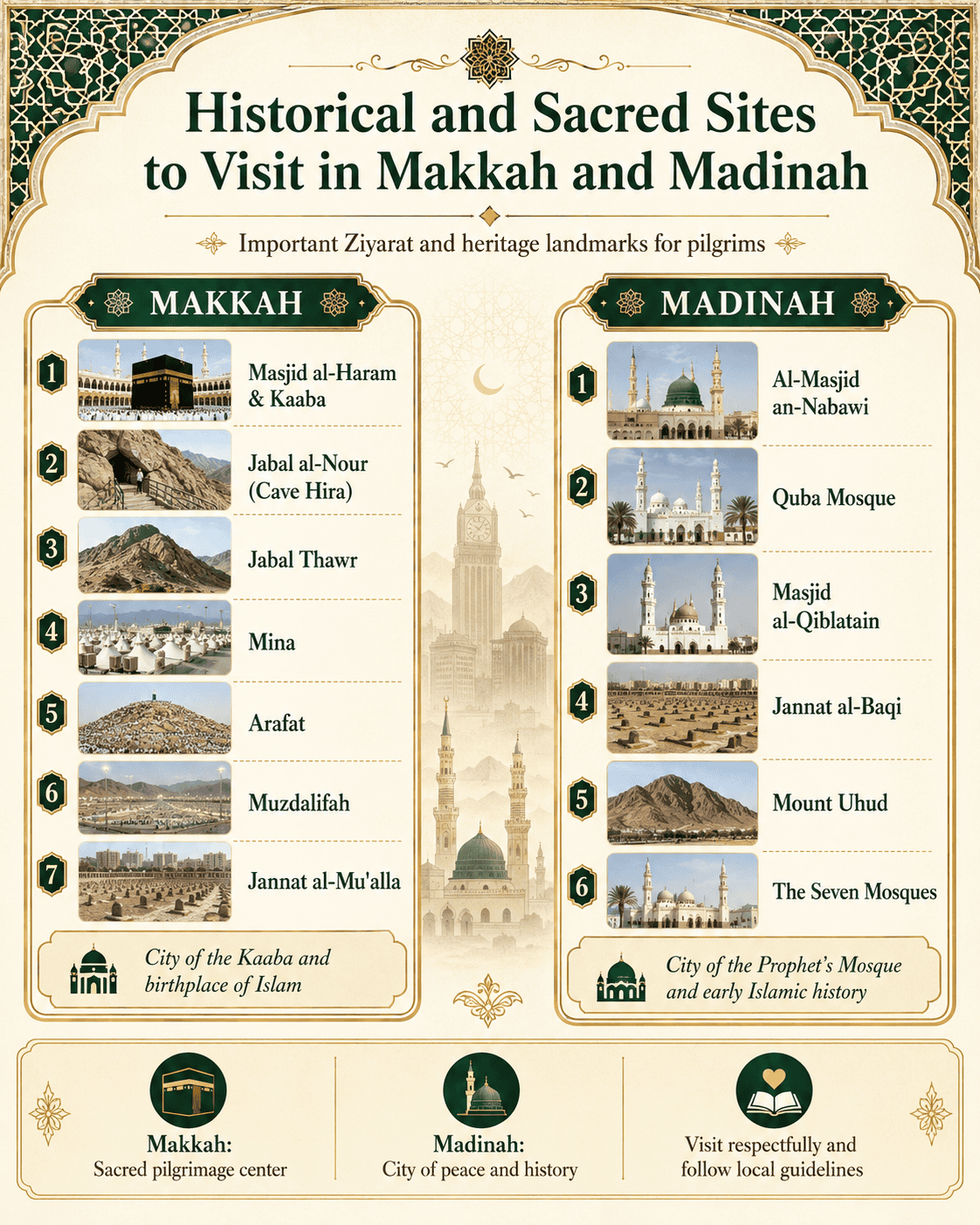
Umrah is not only the rituals of the Haram. The days you spend in Madinah and Makkah offer a rare opportunity to visit places that connect you directly to the early history of Islam — sites where the Prophet ﷺ walked, worshipped, and faced trials that shaped the faith you hold today.
This guide covers the most important Ziyarat sites in both cities, how to reach each one, what to expect when you arrive, and how to fit them into a typical Umrah trip.
What is Ziyarat?
Ziyarat literally means “visitation.” In the context of Umrah and Hajj, it refers to visiting historical and sacred places outside the main mosques — sites connected to Islamic history, the life of the Prophet ﷺ, and the companions.
Important note on intention: The correct intention for Ziyarat is reflection, learning, and gratitude — not worship directed at any site or person. Dua is directed to Allah alone. Visiting these places is about connecting to Islamic history and deepening your understanding of the faith, not venerating the locations themselves.
Ziyarat in Madinah
Most Umrah pilgrims fly into Madinah first and spend 3-4 days before travelling to Makkah. This makes Madinah Ziyarat your first opportunity. We followed this route in February 2023.
1. Masjid an-Nabawi — The Prophet’s Mosque ﷺ
What it is: The second most sacred mosque in Islam, built by the Prophet ﷺ himself after the Hijra to Madinah. The Prophet’s ﷺ tomb is inside this mosque.
The Rawdah (Riyad ul-Jannah): The most sacred area within Masjid an-Nabawi — the space between the Prophet’s ﷺ tomb and his pulpit (minbar). The Prophet ﷺ described it as “a garden from the gardens of Paradise.”
Entry to the Rawdah requires a permit booked through the Nusuk app. Book this as soon as your visa is approved — slots fill quickly. Men’s and women’s visiting times are different.
Visiting tips:
- Arrive at the mosque 30-45 minutes before your Nusuk slot
- Make wudu before arriving — there will be no time inside
- Move calmly and keep your voice low
- Face the Qiblah (not the tomb) when making dua
Distance from most Madinah hotels: Within walking distance — most Zone A and B hotels are 5-15 minutes on foot.
2. Masjid Quba — The First Mosque in Islam
What it is: The first mosque ever built in Islamic history. The Prophet ﷺ laid its foundation stone himself upon arriving in Madinah after the Hijra from Makkah. The Prophet ﷺ said: “Whoever purifies himself in his house, then comes to Masjid Quba and prays in it, he will have a reward like that of Umrah.” (Ibn Majah)
Why this matters: Praying two rak’ahs here carries the reward equivalent to an Umrah. This is one of the most accessible and spiritually significant Ziyarat sites.
How to get there:
- From Masjid an-Nabawi: Approximately 3.5 km south
- By taxi/Uber/Careem: 10-15 minutes, SAR 10-20
- By Ziyarat bus: Included in most organised Ziyarat tours, SAR 20-40 per person
- Walking: 40-50 minutes (not recommended in summer heat)
What to expect: The mosque is large, modern, clean, and air-conditioned. Non-Muslims are not permitted inside. Visit during off-peak prayer times to avoid crowds.
3. Masjid Qiblatayn — The Mosque of Two Qiblahs
What it is: The mosque where the direction of prayer (Qiblah) was changed from Jerusalem (Masjid al-Aqsa) to Makkah (Masjid al-Haram) during the time of the Prophet ﷺ. The change happened mid-prayer — making this a uniquely significant historical site.
How to get there:
- From Masjid an-Nabawi: Approximately 3 km northwest
- By taxi: SAR 10-15
- Often included in Ziyarat bus tours
What to expect: A beautifully maintained mosque. Architecturally interesting — the original building was designed with two mihrabs (prayer niches) facing both directions before the Qiblah change was finalised.
4. Mount Uhud and the Graves of the Martyrs
What it is: The site of the Battle of Uhud (625 CE / 3 AH) — one of the most significant battles in early Islamic history. Over 70 companions of the Prophet ﷺ, including his uncle Hamza (RA), are buried here.
Why visit: The Prophet ﷺ visited the graves of the martyrs of Uhud regularly. This site is a profound reminder of the sacrifices made for Islam in its earliest years.
How to get there:
- From Masjid an-Nabawi: Approximately 5 km north
- By taxi: SAR 15-25
- Most Ziyarat bus tours include this stop
What to expect: An open-air hillside site. The graves are enclosed and clearly marked. You can see the mountain itself and the valley where the battle took place. The site is emotional — particularly standing at Hamza’s (RA) grave. Vendors nearby sell books and items. Respectful silence is appropriate.
Practical: Visit in the early morning. By 10am the sun is strong and the open site offers little shade.
5. Al-Baqi Cemetery
What it is: The main Islamic cemetery of Madinah, located just outside Masjid an-Nabawi. Many companions of the Prophet ﷺ are buried here, as well as members of his family including his wife Khadijah (RA) and his son Ibrahim.
How to get there: Walking distance from Masjid an-Nabawi — the entrance is directly east of the mosque.
What to expect: A large, open cemetery. Men may enter to make dua for the deceased — this is the Sunnah. Women’s access has varying rules — check current guidelines before visiting.
6. Masjid al-Jumu’ah (Masjid Bani Salim)
What it is: The mosque where the Prophet ﷺ offered the first Jumu’ah (Friday) prayer after the Hijra. It marks one of the most significant moments in the establishment of the Muslim community in Madinah.
How to get there: Near Quba mosque — usually visited on the same Ziyarat tour.
Ziyarat in Makkah
After arriving in Makkah and completing your Umrah rituals, the following sites are worth visiting during your remaining days.
7. Cave Hira — Where Revelation Began
What it is: The cave on Jabal an-Nur (Mountain of Light) where the Prophet ﷺ used to go for seclusion and worship before prophethood — and where the first verses of the Quran were revealed to him through the angel Jibreel (AS). The first revelation was Surah Al-Alaq: “Read in the name of your Lord…”
Why this is significant: Standing at the mouth of this cave — where the very first words of the Quran descended — is one of the most moving experiences of an Umrah trip. The cave itself is tiny, fitting perhaps 3-4 people at once.
How to get there:
- From Masjid al-Haram: Approximately 4 km northeast
- By taxi/Uber: SAR 15-25
- Walking from the base of the mountain: 45-60 minutes up approximately 1,000 uneven steps
The climb: This is physically demanding. The path is steep, uneven, and exposed to sun and wind. It takes most people 45-60 minutes to ascend and 30-40 minutes to descend.
Essential preparation:
- Wear proper footwear with grip (not sandals for this climb)
- Bring at least 1 litre of water per person
- Start the climb before 7:00 AM to avoid the worst heat
- Do not attempt this if you have knee problems or are not physically fit
- Elderly pilgrims: This climb is not recommended — the view from the base is beautiful and meaningful without the ascent
At the top: The cave is small and guarded. You can look inside, reflect, and make dua nearby. The view of Makkah from the summit is extraordinary.
8. Cave Thawr — The Cave of the Hijra
What it is: The cave on Jabal Thawr (Mountain of the Bull) where the Prophet ﷺ and Abu Bakr (RA) sheltered for three days during the Hijra from Makkah to Madinah. The Quraysh sent search parties to find them — they passed right by the cave entrance without entering, due to a spider’s web and a dove’s nest that miraculously appeared at the entrance. This story is mentioned in Surah At-Tawbah (9:40).
How to get there: Approximately 4 km south of Masjid al-Haram. The climb is even more challenging than Jabal an-Nur — longer and steeper. Recommended only for those in good physical condition.
9. Masjid al-Jinn
What it is: The mosque built at the site where a group of Jinn are said to have gathered to hear the Quran recited by the Prophet ﷺ — mentioned in Surah Al-Ahqaf and Surah Al-Jinn.
How to get there: Walking distance from Masjid al-Haram. Ask your hotel concierge for directions — it is a small mosque and easy to miss.
10. The Museum of the Two Holy Mosques Architecture
What it is: A museum displaying scale models of Masjid al-Haram and Masjid an-Nabawi across different historical periods, along with artifacts, documents, and exhibits on the history of the holy sites.
Who this is for: Those with a historical interest in the expansion and architecture of the mosques. Also excellent for children.
Admission: Free. Located near Masjid al-Haram.
How to Do Ziyarat — Your Practical Options
Option 1: Organised Ziyarat Bus Tour (Recommended for most pilgrims)
Most hotels in Madinah and Makkah offer Ziyarat bus tours — shared minibuses that visit the main sites in a 3-4 hour circuit.
- Cost: SAR 20-50 per person (approximately ₹440-1,100)
- What’s included: Transport between sites with a guide or driver
- Stops: Typically 5-8 sites per tour
- Booking: Ask at your hotel reception — most hotels can arrange this on the day
This is the most affordable and convenient option for first-time visitors.
Option 2: Uber or Careem (Best for families or those who want flexibility)
Book individual rides between sites using the Uber or Careem app. Both work well in Makkah and Madinah.
- Cost: SAR 10-30 per ride between most Ziyarat sites
- Advantage: Go at your own pace, spend more time at sites that matter to you
- Disadvantage: Slightly more expensive than shared buses if visiting many sites
Download both apps and have them ready before leaving for Saudi Arabia.
Option 3: Walking (Madinah only — for nearby sites)
Some Madinah sites are within walking distance of Masjid an-Nabawi:
- Al-Baqi Cemetery: 5 minutes walk
- Some smaller masajid: 10-20 minutes walk
For longer distances (Quba, Mount Uhud), a vehicle is necessary.
Recommended Ziyarat Schedule for a 4-Day Madinah Stay
Day 1: Arrival in Madinah
After arriving in Madinah, settle into your hotel and take some time to rest. Once you are ready, visit Masjid an-Nabawi for your prayers.
In the evening, you can walk to Al-Baqi Cemetery, which is located near Masjid an-Nabawi.
Day 2: Organised Ziyarat Tour
Start your morning with an organised Ziyarat tour from your hotel or a trusted local operator. Most tours usually cover important sites such as Masjid Quba, Masjid Qiblatayn, Mount Uhud, and a few smaller historical locations.
After the tour, return to your hotel and take rest. Later in the evening, go back to Masjid an-Nabawi for prayers.
Also, check your Nusuk app and confirm your Rawdah permit time if you have already booked one.
Day 3: Rawdah Visit and Personal Worship
On Day 3, attend Rawdah at your booked Nusuk time slot. Try to arrive early, because the area can become crowded.
After your Rawdah visit, spend the rest of the day praying at Masjid an-Nabawi. You can also use this day for personal worship, Qur’an recitation, and shopping for family.
Day 4: Departure to Makkah
On your final day, perform your last prayers at Masjid an-Nabawi before leaving Madinah.
After that, board your SAPTCO bus or arrange private transport to Makkah. Make sure your luggage, tickets, and Ihram items are ready before departure.
Related Articles
- Nusuk App Guide — How to Book Your Rawdah Permit
- SAPTCO Bus from Madinah to Makkah — Complete Guide
- Artal Taiba Hotel Madinah — Honest Review
- How to Perform Umrah Step by Step
- Complete Umrah Packing List 2026
May your Ziyarat deepen your connection to the history of this beautiful religion. Ameen. 🤲
Which site moved you most during your visit? Share in the comments below.
2 thoughts on “Ziyarat Guide — Historical and Sacred Sites to Visit in Makkah and Madinah”