Last updated: 29 October 2026. Every dua below gives its source and how strong the narration is.
Quick answer: the Prophet ﷺ taught one set of words for Sa’i, reported in Sahih Muslim. When you first approach Safa, recite “Innas-Safa wal-Marwata min sha’a’irillah. Abda’u bima bada’allahu bih.” Then, on Safa and again every time you reach Safa or Marwah, face the Kaaba, raise your hands, and say “Allahu akbar” and “La ilaha illallahu wahdahu…” three times, making your own dua in between. There is no special dua for each of the seven laps. While you walk, make any dua you like, in any language.
In this guide
Step by step: what to say during Sa’i
1. Approaching Safa (once, at the very start)
As you walk up to Safa for the first time, recite the verse and the short sentence after it:
Approaching Safa, the first time only
إِنَّ الصَّفَا وَالْمَرْوَةَ مِنْ شَعَائِرِ اللَّهِ، أَبْدَأُ بِمَا بَدَأَ اللَّهُ بِهِ
Innas-Safa wal-Marwata min sha’a’irillah. Abda’u bima bada’allahu bih.
“Indeed, Safa and Marwah are among the symbols of Allah.” (Quran 2:158) “I begin with what Allah began with.”
بے شک صفا اور مروہ اللہ کی نشانیوں میں سے ہیں۔ میں اسی سے شروع کرتا ہوں جس سے اللہ نے شروع کیا۔ (خواتین: کرتی ہوں)
Source: Sahih Muslim 1218 (the hadith of Jabir). Grade: sahih. Said once, when you first approach Safa.
You recite the verse only once, at the start of Sa’i. You don’t repeat it at Marwah or on later laps.
2. On Safa: face the Kaaba and say the dhikr three times
Go up onto Safa and face the Kaaba. From Safa you can usually see it through the arches; if you can’t, just face its direction. Raise your hands as you do for dua, not as in the opening of prayer, and say:
On Safa and on Marwah, facing the Kaaba
اللَّهُ أَكْبَرُ، اللَّهُ أَكْبَرُ، اللَّهُ أَكْبَرُ. لَا إِلَهَ إِلَّا اللَّهُ وَحْدَهُ لَا شَرِيكَ لَهُ، لَهُ الْمُلْكُ وَلَهُ الْحَمْدُ، وَهُوَ عَلَى كُلِّ شَيْءٍ قَدِيرٌ. لَا إِلَهَ إِلَّا اللَّهُ وَحْدَهُ، أَنْجَزَ وَعْدَهُ، وَنَصَرَ عَبْدَهُ، وَهَزَمَ الْأَحْزَابَ وَحْدَهُ
Allahu akbar, Allahu akbar, Allahu akbar. La ilaha illallahu wahdahu la sharika lah, lahul-mulku wa lahul-hamd, wa huwa ‘ala kulli shay’in qadir. La ilaha illallahu wahdah, anjaza wa’dah, wa nasara ‘abdah, wa hazamal-ahzaba wahdah.
“Allah is the Greatest. There is no god but Allah alone, with no partner. His is the dominion and His is the praise, and He has power over all things. There is no god but Allah alone. He fulfilled His promise, helped His servant, and alone defeated the confederates.”
اللہ سب سے بڑا ہے۔ اللہ کے سوا کوئی معبود نہیں، وہ اکیلا ہے، اس کا کوئی شریک نہیں، اسی کی بادشاہی ہے اور اسی کے لیے سب تعریف ہے، اور وہ ہر چیز پر قادر ہے۔ اللہ کے سوا کوئی معبود نہیں، وہ اکیلا ہے، اس نے اپنا وعدہ پورا کیا، اپنے بندے کی مدد کی اور اکیلے ہی لشکروں کو شکست دی۔
Source: Sahih Muslim 1218. Grade: sahih. The Prophet ﷺ said this three times, making his own dua in between. Abu Dawud 1905 (sahih) adds yuhyi wa yumit (“He gives life and causes death”) after lahul-hamd; either wording is fine. Muslim does not give a number for the takbir; saying it three times is common practice.
Say it, then make your own dua for whatever you want. Say it a second time, make dua again, then say it a third time. This is the moment of Sa’i most clearly taught in the Sunnah, so don’t rush it.
3. Walk to Marwah
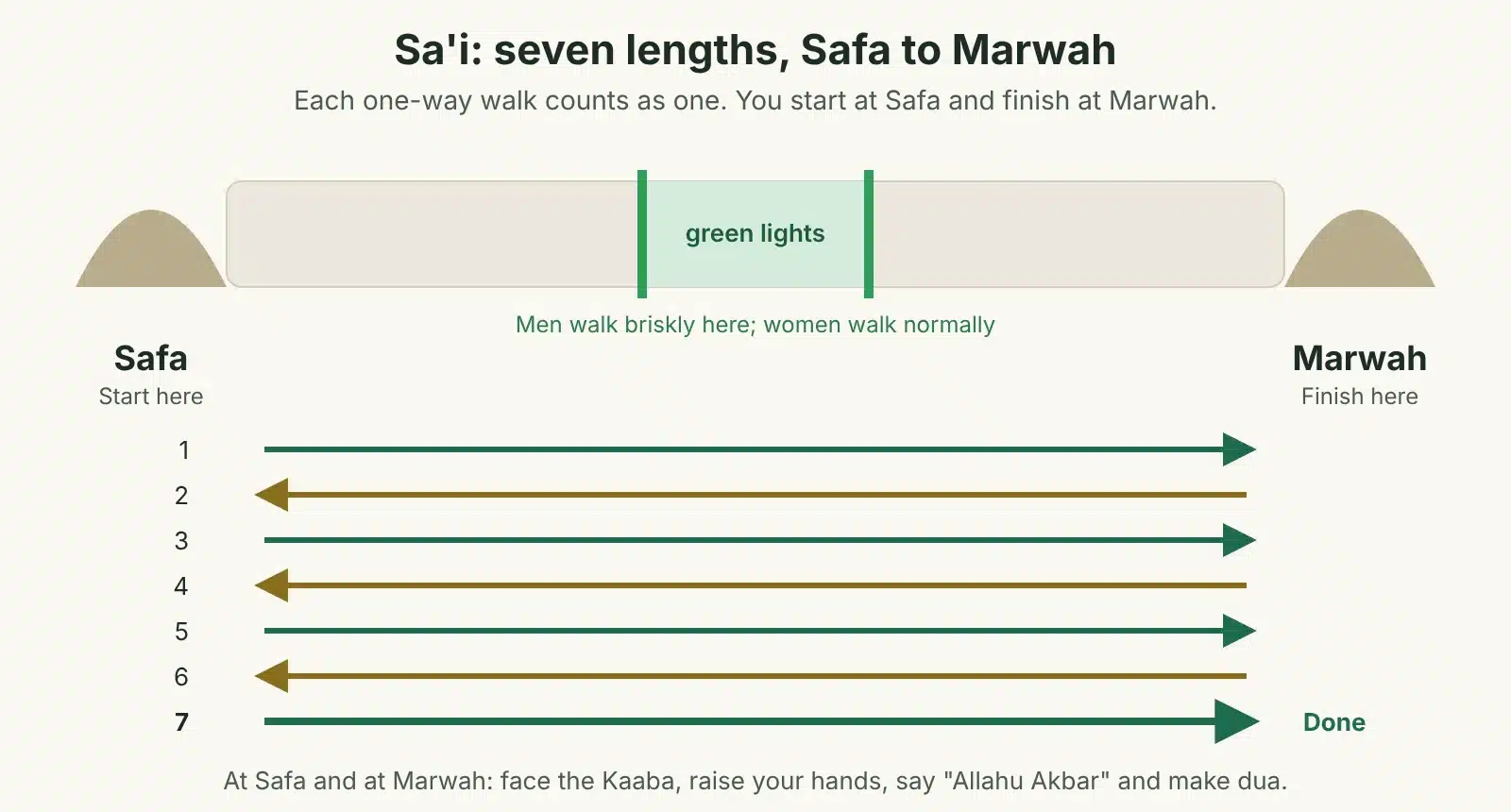
Walk towards Marwah, making dua, dhikr or reciting Quran. Between the two green lights, men walk briskly; women walk at their normal pace (see below).
4. On Marwah: repeat what you did on Safa
At Marwah, face the Kaaba and repeat the same takbir, the same La ilaha illallah… words and your own dua, three times. The Prophet ﷺ “did on Marwah what he had done on Safa” (Muslim 1218). Only the Quran verse is left out.
5. Repeat for all seven laps, finishing at Marwah
Safa to Marwah is one lap; Marwah back to Safa is the second. You finish the seventh lap at Marwah.
What to say on each of the 7 laps
Here is where each dhikr falls. Every stop on a hill gets the same words; the walking in between is free for your own dua.
| Lap | Direction | At the start of the lap | While walking |
|---|---|---|---|
| Before lap 1 | At Safa | Quran 2:158 and Abda’u bima bada’allahu bih, then the dhikr ×3 with dua | — |
| 1 | Safa → Marwah | Begin walking | Your own dua; men walk briskly between the green lights |
| 2 | Marwah → Safa | On Marwah: dhikr ×3 with dua | Your own dua |
| 3 | Safa → Marwah | On Safa: dhikr ×3 with dua | Your own dua |
| 4 | Marwah → Safa | On Marwah: dhikr ×3 with dua | Your own dua |
| 5 | Safa → Marwah | On Safa: dhikr ×3 with dua | Your own dua |
| 6 | Marwah → Safa | On Marwah: dhikr ×3 with dua | Your own dua |
| 7 | Safa → Marwah | On Safa: dhikr ×3 with dua | Your own dua. Sa’i ends when you reach Marwah |
Is there a different dua for each lap?
No. Many booklets and websites print a long, different dua for every lap of Sa’i. None of these come from the Prophet ﷺ or his Companions. The authentic words are the verse at the start, the dhikr on Safa and Marwah, and whatever you choose to ask for while walking. Scholars such as Ibn Uthaymin warned against treating a fixed per-lap dua as part of the Sunnah.
That doesn’t mean those duas are wrong to say. If a printed dua is good in meaning and helps you, you may read it as your own personal dua. Just don’t believe your Sa’i is incomplete without it, and don’t rush the dhikr on the hills to finish a long booklet.
The green lights: what to say and who walks fast
The two green-lit markers show the low valley where Hajar ran while searching for water for her son Ismail. Between them, men walk briskly or jog lightly, following the Prophet ﷺ (Muslim 1218). Women walk at their normal pace; Ibn Umar said women do not jog in Sa’i, and scholars report agreement on this.
Two Companions, Ibn Mas’ud and Ibn Umar, used to say this short dua in the valley. It is authentic as their practice, not as words of the Prophet ﷺ, so say it if you like it:
Between the green lights (optional)
رَبِّ اغْفِرْ وَارْحَمْ، إِنَّكَ أَنْتَ الْأَعَزُّ الْأَكْرَمُ
Rabbighfir warham, innaka antal-a’azzul-akram.
“My Lord, forgive and have mercy. You are the Most Mighty, the Most Generous.”
اے میرے رب! بخش دے اور رحم فرما، بے شک تو ہی سب سے زیادہ غالب اور سب سے زیادہ کرم والا ہے۔
Source: said by the Companions Abdullah ibn Mas’ud and Abdullah ibn Umar in the valley between Safa and Marwah (Musannaf Ibn Abi Shaybah; al-Bayhaqi). Grade: authentic as a Companion’s practice (mawquf). The version attributed to the Prophet ﷺ himself is weak.
Other duas you can say while walking
Between the hills you are free: ask Allah for anything, in your own language. If you prefer words from the Quran, these short duas are easy to remember (all optional):
رَبَّنَا آتِنَا فِي الدُّنْيَا حَسَنَةً وَفِي الْآخِرَةِ حَسَنَةً وَقِنَا عَذَابَ النَّارِ
Rabbana atina fid-dunya hasanatan wa fil-akhirati hasanatan wa qina ‘adhaban-nar.
“Our Lord, give us good in this world and good in the Hereafter, and protect us from the punishment of the Fire.” (Quran 2:201)
اے ہمارے رب! ہمیں دنیا میں بھلائی دے اور آخرت میں بھی بھلائی دے اور ہمیں آگ کے عذاب سے بچا۔
رَبَّنَا تَقَبَّلْ مِنَّا، إِنَّكَ أَنْتَ السَّمِيعُ الْعَلِيمُ
Rabbana taqabbal minna, innaka antas-Sami’ul-‘Alim.
“Our Lord, accept this from us. You are the All-Hearing, the All-Knowing.” (Quran 2:127, the dua of Ibrahim and Ismail)
اے ہمارے رب! ہم سے قبول فرما، بے شک تو ہی سب کچھ سننے والا، سب کچھ جاننے والا ہے۔
رَبَّنَا لَا تُزِغْ قُلُوبَنَا بَعْدَ إِذْ هَدَيْتَنَا وَهَبْ لَنَا مِنْ لَدُنْكَ رَحْمَةً، إِنَّكَ أَنْتَ الْوَهَّابُ
Rabbana la tuzigh qulubana ba’da idh hadaytana wa hab lana min ladunka rahmah, innaka antal-Wahhab.
“Our Lord, do not let our hearts swerve after You have guided us, and grant us mercy from Yourself. You are the Giver.” (Quran 3:8)
اے ہمارے رب! ہدایت دینے کے بعد ہمارے دلوں کو ٹیڑھا نہ کر اور ہمیں اپنی طرف سے رحمت عطا فرما، بے شک تو ہی بہت عطا کرنے والا ہے۔
Remembering Hajar, who trusted Allah while running between these same hills, is part of the meaning of Sa’i. Many pilgrims use the walk to ask for things they feel helpless about, as she did.
After the seventh lap
Sa’i ends when you reach Marwah at the end of the seventh lap. There is no special prayer or dua to mark the end. For Umrah, your last step is to shave or shorten your hair (men) or cut about a fingertip’s length (women), and then you leave Ihram. Our step-by-step Umrah guide covers this.
Quick rulings for Sa’i
- Wudu: recommended, but not a condition for Sa’i according to the four schools. If you lose wudu during Sa’i, you can carry on.
- Periods: a woman who gets her period after Tawaf may still do Sa’i, because Sa’i doesn’t require ritual purity. (Tawaf does.)
- Losing count: go with the lower number you are sure of and continue from there.
- Breaks: you can stop to pray when the iqamah is called, or rest, and then continue from where you stopped.
- Floors and wheelchairs: Sa’i is valid on every floor of the Mas’a. Wheelchair lanes and electric carts are available; ask at the Haram’s service counters.
- Facing the Kaaba: on Safa and Marwah you face the Kaaba; you don’t need to climb to the very top.
Common mistakes in Sa’i
- Reciting “Innas-Safa wal-Marwah…” at the start of every lap. It is only for the first approach to Safa.
- Raising both hands with palms facing the Kaaba, as in the opening of prayer, and moving on. Raise your hands in dua and stay for the dhikr.
- Women jogging between the green lights. Only men walk briskly there.
- Counting a full round trip (Safa to Marwah and back) as one lap. Each one-way walk is a lap.
- Believing Sa’i is incomplete without a booklet’s dua for each lap.
- Praying two rak’ahs after Sa’i as if it were part of the rite. There is no such prayer in the Sunnah.
Free printable Sa’i dua card
We made a one-page card with the Safa verse, the dhikr for Safa and Marwah, and the green-lights dua, in Arabic, transliteration, English and Urdu. Print it, or save the image to your phone.
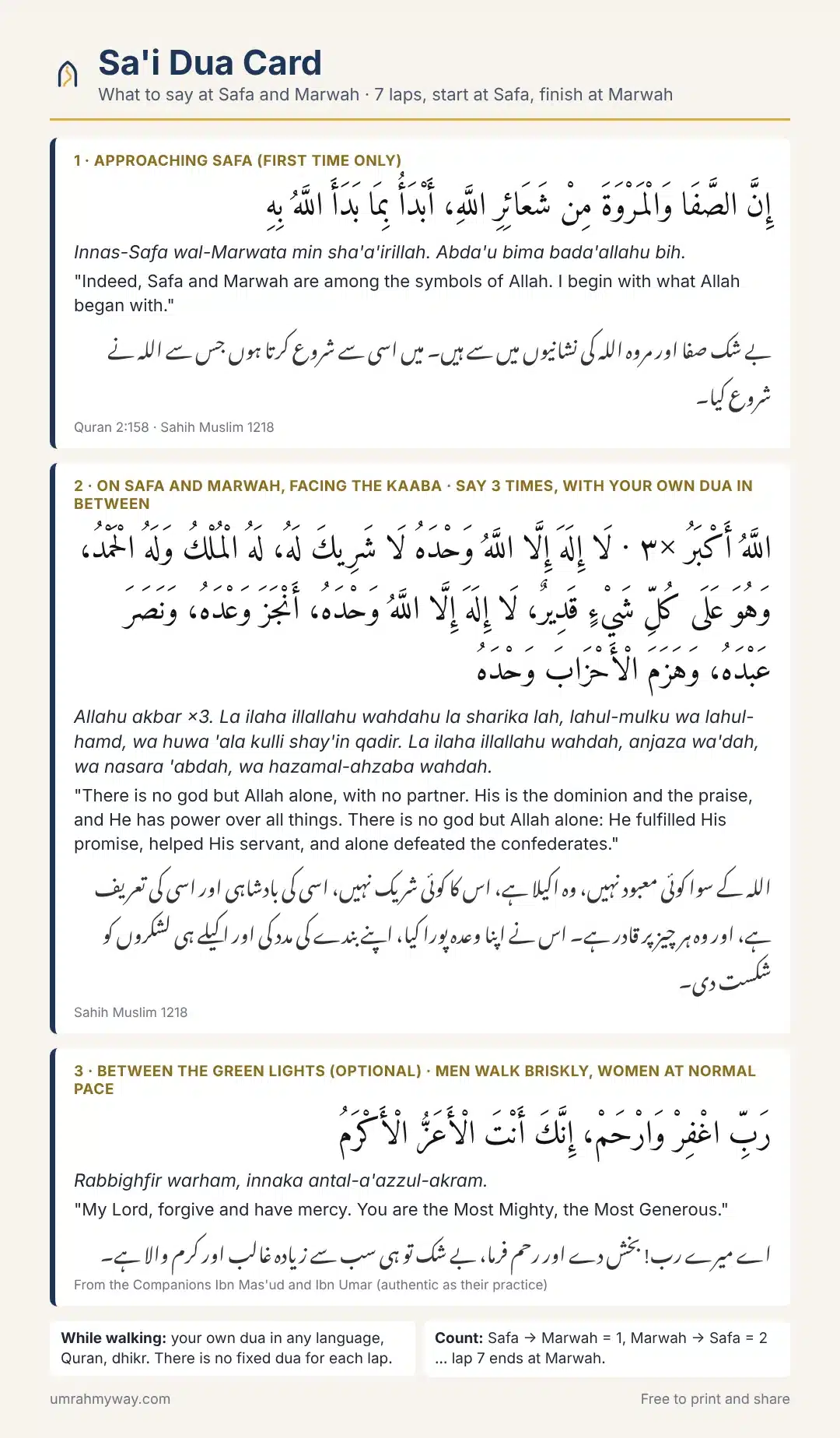
Download the printable PDF Save the image for your phone
Frequently asked questions
What dua do you say at Safa and Marwah?
On first approaching Safa, recite “Innas-Safa wal-Marwata min sha’a’irillah” and “Abda’u bima bada’allahu bih”. Then on Safa, and every time you reach Safa or Marwah, face the Kaaba and say “Allahu akbar” and “La ilaha illallahu wahdahu…” three times, with your own dua in between (Sahih Muslim 1218).
What do you recite while walking during Sa’i?
Anything good: your own dua in any language, Quran, or dhikr such as Subhanallah, Alhamdulillah and La ilaha illallah. Some Companions said “Rabbighfir warham, innaka antal-a’azzul-akram” between the green lights.
Is there a dua for each of the 7 rounds of Safa and Marwah?
No. No authentic narration gives a different dua for each lap. The same dhikr is repeated on each hill, and the rest is your own dua.
Do you say the dua at every stop or only once?
The Quran verse is said once, at the start. The takbir and “La ilaha illallah…” dhikr is said on Safa and on Marwah every time you arrive, three times each.
What do you do when you finish Safa and Marwah?
Sa’i ends at Marwah after the seventh lap. For Umrah, men then shave or shorten their hair and women cut a small amount, which completes Umrah.
Do I need wudu for Sa’i?
It is better to have wudu, but it is not a condition for Sa’i.
Can I read the dua from my phone or in English?
Yes. You can read from a phone or card, and you can make your own dua in English, Urdu or any language. For the Sunnah dhikr, try to learn the Arabic, or read it from the card below the transliteration.
Do women walk fast between the green lights?
No. Women walk at a normal pace for the whole of Sa’i.
How long is Sa’i?
The Mas’a between Safa and Marwah is about 375 m long, so seven laps are about 2.6 km. Most people take 40–60 minutes.
Sources
- Sahih Muslim 1218: the Prophet’s Hajj, described by Jabir
- Sunan Abi Dawud 1905
- Quran 2:158
- HadithAnswers: the dua between Safa and Marwah
- IslamQA 34744: duas during Umrah
- Saudipedia: length of the Mas’a
- IslamQA 109174: no specific dua for each lap
- IslamQA 34695: purity for Tawaf and Sa’i