Last updated: 29 October 2026. Each dua below gives its source and how strong the narration is, in Arabic, transliteration, English and Urdu.
Quick answer: the Sunnah gives only two fixed phrases for Tawaf. At the Black Stone, at the start of every round, point to it and say “Allahu akbar”. Between the Yemeni corner and the Black Stone, say “Rabbana atina fid-dunya hasanatan…”. For the rest of each round, make your own dua in any language, remember Allah, or recite Quran. There is no separate dua for each of the seven rounds.
In this guide
Where each dua is said
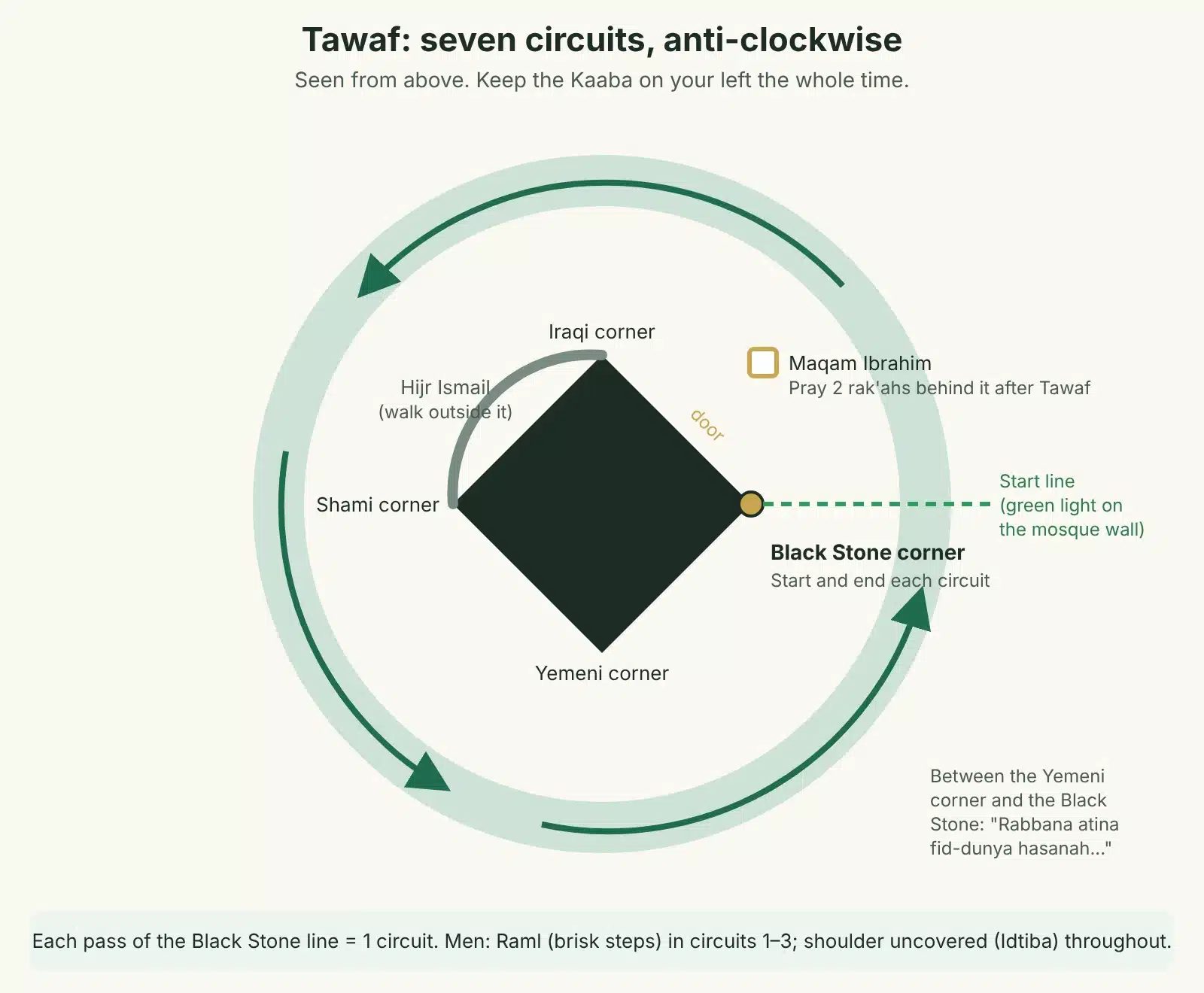
Tawaf goes anti-clockwise, with the Kaaba on your left. Each round starts and ends at the line of the Black Stone corner, which is marked by a green light on the mosque wall.
At the Black Stone: start of every round
Face the Black Stone, or simply turn towards it from where you are. If you can reach it without pushing, touch or kiss it; otherwise raise your right hand towards it once, and don’t kiss your hand. Then say:
At the Black Stone, at the start of every round
اللَّهُ أَكْبَرُ
Allahu akbar.
“Allah is the Greatest.”
اللہ سب سے بڑا ہے۔
Source: Sahih al-Bukhari 1613: each time the Prophet ﷺ came to the corner of the Black Stone, he pointed to it and said takbir. Grade: sahih.
Also good, from Ibn Umar
بِسْمِ اللَّهِ وَاللَّهُ أَكْبَرُ
Bismillahi wallahu akbar.
“In the name of Allah, and Allah is the Greatest.”
اللہ کے نام سے، اور اللہ سب سے بڑا ہے۔
Source: the practice of Abdullah ibn Umar (Abd al-Razzaq; al-Bayhaqi). Grade: authentic chain, as a Companion’s practice (mawquf). Note the “wa”: it is Bismillahi wallahu akbar.
Do this at the start of each of the seven rounds. Many guides write “Bismillahi Allahu akbar” without the “wa”, but the reported wording is “Bismillahi wallahu akbar”, and the takbir alone is what the Prophet ﷺ is reported to have said.
Between the Yemeni corner and the Black Stone
The Yemeni corner is the corner before the Black Stone. If you can, touch it with your right hand as you pass; don’t kiss it, point at it or say takbir there. Then, on the short stretch from the Yemeni corner to the Black Stone, say:
Between the Yemeni corner and the Black Stone, every round
رَبَّنَا آتِنَا فِي الدُّنْيَا حَسَنَةً وَفِي الْآخِرَةِ حَسَنَةً وَقِنَا عَذَابَ النَّارِ
Rabbana atina fid-dunya hasanatan wa fil-akhirati hasanatan wa qina ‘adhaban-nar.
“Our Lord, give us good in this world and good in the Hereafter, and protect us from the punishment of the Fire.” (Quran 2:201)
اے ہمارے رب! ہمیں دنیا میں بھی بھلائی عطا فرما اور آخرت میں بھی بھلائی عطا فرما اور ہمیں آگ کے عذاب سے بچا۔
Source: Sunan Abi Dawud 1892 (Abdullah ibn al-Sa’ib heard the Prophet ﷺ say it between the two corners). Grade: hasan (al-Albani).
What to say during the rest of each round
Most of each round has no fixed words. This is your time with Allah. The Prophet ﷺ said that Tawaf around the House is like prayer, except that you may speak, so speak only good (Tirmidhi 960). You can:
- Make your own dua, in Urdu, English or any language. Allah understands every language.
- Recite any Quran you know.
- Say dhikr: Subhanallah, Alhamdulillah, La ilaha illallah, Allahu akbar, Astaghfirullah, and send salawat on the Prophet ﷺ.
- Repeat a few short duas from the Quran and Sunnah that you know well.
Say your dua quietly, so you don’t disturb the people around you. Group leaders reciting loudly for others to repeat is common, but it isn’t from the Sunnah and can make it hard for others to concentrate.
A 7-round dua plan (optional)
People search for “the dua for each of the 7 rounds” because it helps to have a plan. Here is one way to organise your own dua so you don’t forget anything. This is a personal suggestion, not a Sunnah sequence: swap the themes around or ignore them completely.
Round 1: Forgiveness
رَبِّ اغْفِرْ لِي وَتُبْ عَلَيَّ، إِنَّكَ أَنْتَ التَّوَّابُ الرَّحِيمُ
Rabbighfir li wa tub ‘alayya, innaka antat-Tawwabur-Rahim.
“My Lord, forgive me and accept my repentance. You are the Accepter of repentance, the Merciful.” (Abu Dawud 1516, sahih)
اے میرے رب! مجھے بخش دے اور میری توبہ قبول فرما، بے شک تو توبہ قبول کرنے والا، رحم کرنے والا ہے۔
Round 2: Guidance and a firm heart
رَبَّنَا لَا تُزِغْ قُلُوبَنَا بَعْدَ إِذْ هَدَيْتَنَا وَهَبْ لَنَا مِنْ لَدُنْكَ رَحْمَةً، إِنَّكَ أَنْتَ الْوَهَّابُ
Rabbana la tuzigh qulubana ba’da idh hadaytana wa hab lana min ladunka rahmah, innaka antal-Wahhab.
“Our Lord, do not let our hearts swerve after You have guided us, and grant us mercy from Yourself. You are the Giver.” (Quran 3:8)
اے ہمارے رب! ہدایت کے بعد ہمارے دلوں کو ٹیڑھا نہ کر اور ہمیں اپنی رحمت عطا فرما، بے شک تو ہی عطا کرنے والا ہے۔
Round 3: Parents
رَبِّ ارْحَمْهُمَا كَمَا رَبَّيَانِي صَغِيرًا
Rabbir-hamhuma kama rabbayani saghira.
“My Lord, have mercy on them as they raised me when I was small.” (Quran 17:24)
اے میرے رب! ان دونوں پر رحم فرما جیسے انہوں نے بچپن میں میری پرورش کی۔
Round 4: Spouse and children
رَبَّنَا هَبْ لَنَا مِنْ أَزْوَاجِنَا وَذُرِّيَّاتِنَا قُرَّةَ أَعْيُنٍ وَاجْعَلْنَا لِلْمُتَّقِينَ إِمَامًا
Rabbana hab lana min azwajina wa dhurriyyatina qurrata a’yunin waj’alna lil-muttaqina imama.
“Our Lord, give us joy in our spouses and children, and make us leaders of the God-conscious.” (Quran 25:74)
اے ہمارے رب! ہمیں ہمارے ازواج اور اولاد سے آنکھوں کی ٹھنڈک عطا فرما اور ہمیں پرہیزگاروں کا پیشوا بنا۔
Round 5: Wellbeing in this life and the next
اللَّهُمَّ إِنِّي أَسْأَلُكَ الْعَافِيَةَ فِي الدُّنْيَا وَالْآخِرَةِ
Allahumma inni as’alukal-‘afiyata fid-dunya wal-akhirah.
“O Allah, I ask You for wellbeing in this world and the Hereafter.” (Abu Dawud 5074, sahih)
اے اللہ! میں تجھ سے دنیا اور آخرت میں عافیت مانگتا ہوں۔
Round 6: People who asked you for dua
Name them, one by one, in your own words. Anyone who asked you to remember them, friends who are ill, and Muslims everywhere.
Round 7: Acceptance
رَبَّنَا تَقَبَّلْ مِنَّا، إِنَّكَ أَنْتَ السَّمِيعُ الْعَلِيمُ
Rabbana taqabbal minna, innaka antas-Sami’ul-‘Alim.
“Our Lord, accept this from us. You are the All-Hearing, the All-Knowing.” (Quran 2:127)
اے ہمارے رب! ہم سے قبول فرما، بے شک تو ہی سننے والا، جاننے والا ہے۔
In every round, finish with “Rabbana atina…” between the Yemeni corner and the Black Stone.
After the seventh round
This is the order the Prophet ﷺ followed, as described in Sahih Muslim 1218:
- Men cover the right shoulder again if it was uncovered.
- Walk towards Maqam Ibrahim, reciting the verse below.
- Pray two rak’ahs behind the Maqam if there is space, or anywhere in the mosque if it is crowded. Recite Surah al-Kafirun and Surah al-Ikhlas.
- If it’s easy, go back and touch the Black Stone, then head to Safa for Sa’i.
Drinking Zamzam at this point is also recommended: a narration in Musnad Ahmad, from Jabir, describes the Prophet ﷺ drinking Zamzam and pouring some on his head before returning to the Black Stone. Make dua while you drink.
Walking to Maqam Ibrahim after the seventh round
وَاتَّخِذُوا مِنْ مَقَامِ إِبْرَاهِيمَ مُصَلًّى
Wattakhidhu min maqami Ibrahima musalla.
“And take the station of Ibrahim as a place of prayer.” (Quran 2:125)
اور مقامِ ابراہیم کو نماز کی جگہ بناؤ۔
Source: Sahih Muslim 1218: the Prophet ﷺ recited this verse as he went to the Maqam after Tawaf. Grade: sahih.
When drinking Zamzam (optional)
اللَّهُمَّ إِنِّي أَسْأَلُكَ عِلْمًا نَافِعًا، وَرِزْقًا وَاسِعًا، وَشِفَاءً مِنْ كُلِّ دَاءٍ
Allahumma inni as’aluka ‘ilman nafi’an, wa rizqan wasi’an, wa shifa’an min kulli da’.
“O Allah, I ask You for beneficial knowledge, plentiful provision, and healing from every illness.”
اے اللہ! میں تجھ سے نفع دینے والا علم، کشادہ رزق اور ہر بیماری سے شفا مانگتا ہوں۔
Source: reported from Ibn Abbas (al-Daraqutni; al-Hakim); scholars dispute the chain. Fine to say as a general dua. The hadith “Zamzam water is for whatever it is drunk for” (Ibn Majah 3062) is graded sahih by al-Albani and hasan by others.
Men in the first three rounds: Raml and Idtiba
- Idtiba: during the Tawaf of Umrah, men wear the upper Ihram cloth under the right armpit, leaving the right shoulder bare, for all seven rounds. Cover it again before praying.
- Raml: men walk briskly, with short steps, in the first three rounds, and at a normal pace in the last four, if the crowd allows (Muslim 1218; Abu Dawud 1889).
- Women do neither. Both apply only to the Tawaf you do on arrival, such as the Tawaf of Umrah, not to voluntary Tawaf.
The Talbiyah of Umrah stops when you begin Tawaf. Don’t keep saying “Labbayk” during the rounds.
The dua on first seeing the Kaaba
A dua often printed for this moment, “Allahumma zid hadhal-bayta tashrifan…” (“O Allah, increase this House in honour…”), comes through weak chains, though al-Shafi’i and others recommended it. Another, “Allahumma antas-salam wa minkas-salam, fa hayyina Rabbana bis-salam”, is reported from Umar. You can say either as a general dua, or simply raise your hands and ask Allah for what matters most to you.
How long is Tawaf?
It depends on where you walk. The closer you are to the Kaaba, the shorter each round:
| Where you walk | One round | Seven rounds |
|---|---|---|
| Ground floor, right next to the Kaaba | About 75–80 m | About 0.5–0.6 km |
| Middle of the open courtyard (Mataf) | About 120–250 m | About 0.85–1.75 km |
| Outer edge of the courtyard | About 400 m | About 2.8 km |
| First floor, upper floors and roof | About 285–725 m | About 2–5 km |
On the ground floor, seven rounds usually take 30–60 minutes depending on the crowd; on the roof it can take an hour and a half. Distances are approximate, from the Madain Project and The Pilgrim.
Quick rulings for Tawaf
- Wudu: the majority of scholars (Maliki, Shafi’i, Hanbali) make wudu a condition for Tawaf, and in the Hanafi school it is obligatory. Make wudu before you start. If you lose it during Tawaf, renew it; scholars differ on whether to restart or continue.
- Losing count: go with the lower number you are sure of.
- Prayer during Tawaf: when the iqamah is called, pray with the congregation, then continue from where you stopped.
- Periods: a woman who is menstruating does not perform Tawaf until she is pure; she can do everything else.
- Hijr Ismail: walk outside the low curved wall, because it is part of the Kaaba.
- Wheelchairs and carts: available on the upper floors; Tawaf there is valid.
Common mistakes
- Thinking Tawaf is invalid without a booklet’s dua for each round.
- Pushing or hurting people to kiss the Black Stone. Pointing is enough.
- Kissing or pointing at the Yemeni corner, or saying takbir there: none of these is established in the Sunnah.
- Continuing the Talbiyah during Tawaf.
- Walking inside the Hijr Ismail wall.
- Starting the round before the Black Stone line, or counting from somewhere else.
- Rushing past the Black Stone without the takbir.
Free printable Tawaf dua card
A one-page card with the takbir, “Rabbana atina”, the Maqam verse and the 7-round plan, in Arabic, transliteration, English and Urdu. Print it or save the image to your phone.
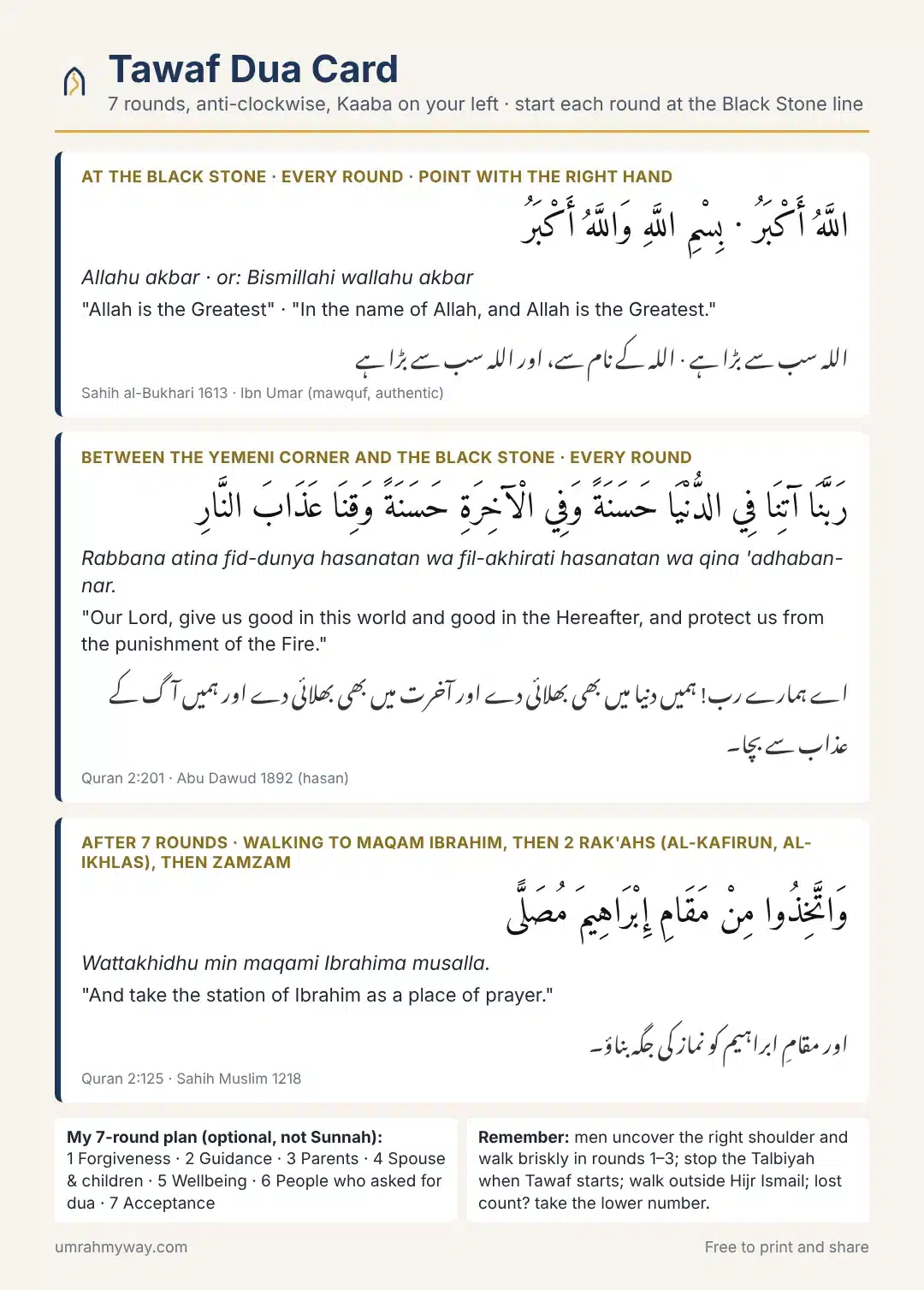
Download the printable PDF Save the image for your phone
Frequently asked questions
What is the dua for the 7 rounds of Tawaf?
There is no separate authentic dua for each round. In every round, say “Allahu akbar” at the Black Stone and “Rabbana atina fid-dunya hasanatan…” between the Yemeni corner and the Black Stone; the rest is your own dua.
What should I say during Tawaf?
Any dua, dhikr or Quran you like, quietly, in any language. Only the takbir at the Black Stone and the dua between the two corners are fixed.
How do I make dua in Tawaf?
Keep walking and speak to Allah quietly in your own words. Raise your hands only when pointing to the Black Stone; for the rest of the round, keep your hands down and keep moving with the crowd.
Can I read the Tawaf dua from my phone or a PDF?
Yes. Just keep an eye on the crowd and don’t stop in the flow of people.
Can I make dua in Urdu or English during Tawaf?
Yes. Personal dua can be in any language. Only the takbir and “Rabbana atina” are usually said in Arabic.
Is there a dua for the farewell Tawaf?
No special one. Do it like any Tawaf, and make dua for a safe return and for Allah to accept your Umrah.
How many km is one Tawaf?
Seven rounds are about 0.5–2.8 km on the ground floor, depending on how close you are to the Kaaba, and about 2–5 km on the upper floors and roof.
What should I do if I forget which round I am on?
Count the lower number you are sure of and carry on from there.
Sources
- Sahih al-Bukhari 1613
- Sunan Abi Dawud 1892
- Sahih Muslim 1218
- Sunan Abi Dawud 1889
- Jami’ al-Tirmidhi 960
- IslamQA 20425: the Yemeni corner
- IslamQA 109246: no fixed dua for each round
- IslamQA 34695: wudu for Tawaf
- Madain Project: Tawaf distance