Last updated: August 2026
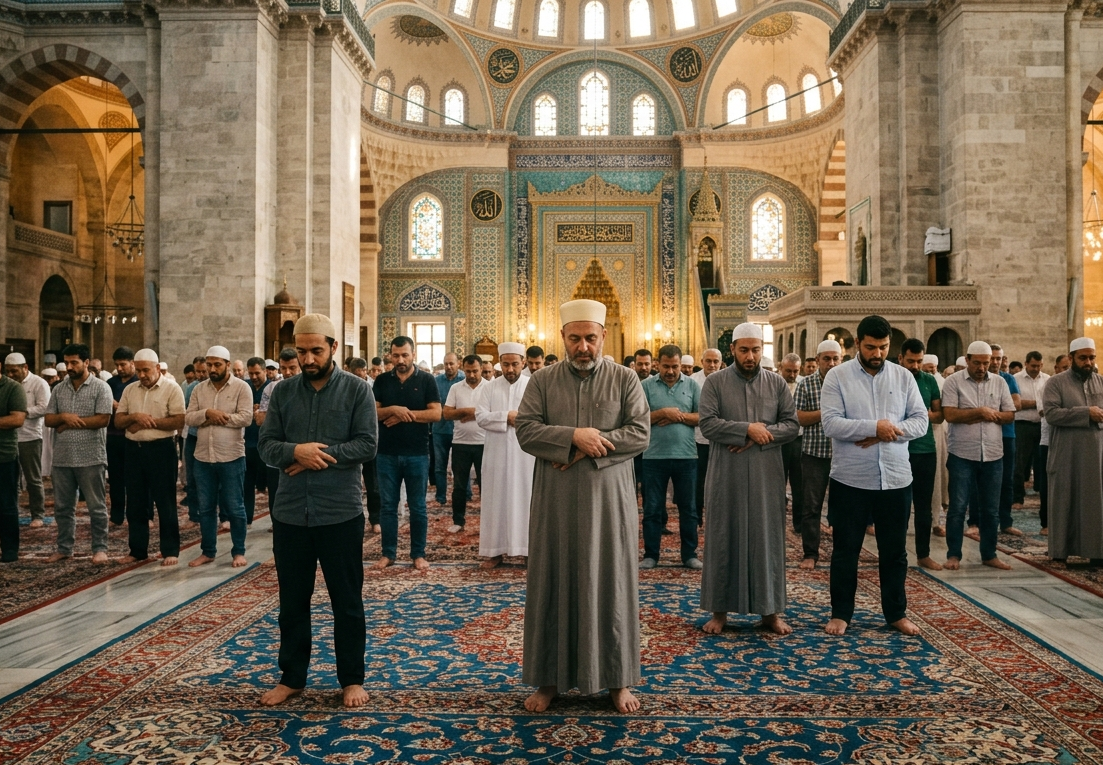
Salah (namaz) is the second pillar of Islam and the first thing a person will be asked about on the Day of Judgement. For a new Muslim or anyone learning to pray, the movements and words can feel overwhelming at first — but the prayer is built from a single repeating unit called a rak’ah. Learn one rak’ah, and you know the whole prayer.
This guide walks you through everything: what you need before you start, one complete rak’ah with every position and the full Arabic recitations, how to finish the prayer, and exactly what to do for each of the five daily prayers.
You must have valid wudu before praying. If you haven’t learned it, read our step-by-step wudu guide first, then return here. For the full Arabic of every recitation with transliteration and meaning, see our companion guide, Salah Recitations.
Who Must Pray, and When
Prayer is obligatory on every sane adult Muslim. A person becomes accountable at puberty (signs include reaching the age of about 15 lunar years if other signs haven’t appeared).
There are five obligatory prayers each day, each with a set number of rak’ahs:
| Prayer | Time | Obligatory Rak’ahs |
|---|---|---|
| Fajr | Dawn, before sunrise | 2 |
| Dhuhr | After midday | 4 |
| Asr | Afternoon | 4 |
| Maghrib | Just after sunset | 3 |
| Isha | Night | 4 |
Each prayer should be performed once its time begins and not delayed without a valid reason. A deliberately missed prayer is a serious matter and should be made up as soon as it is remembered.
The Sunnah prayers (recommended, not obligatory)
Alongside the obligatory (Fard) rak’ahs, there are recommended Sunnah rak’ahs. You are rewarded for them but not sinful for leaving them. A common pattern:
| Prayer | Sunnah before | Fard | Sunnah after |
|---|---|---|---|
| Fajr | 2 | 2 | — |
| Dhuhr | 2 (or 4) | 4 | 2 |
| Asr | — | 4 | — |
| Maghrib | — | 3 | 2 |
| Isha | — | 4 | 2 |
This guide teaches the obligatory (Fard) prayer — the same rak’ah structure applies to the Sunnah prayers too.
Before You Begin — The Requirements
Before starting, make sure (where possible) you have:
- Wudu (ablution) — you must be in a state of purity.
- Clean body, clothing, and place — free from impurities.
- Covered the awrah — men from the navel to the knees, with the shoulders covered; women covering the whole body except the face and hands. Clothing should be loose and non-transparent.
- The prayer time has begun.
- Facing the Qibla — the direction of the Kaaba in Makkah. A compass or phone app can help you find it.
- The intention (Niyyah) — in your heart, intend which specific prayer you are about to perform. It is not spoken aloud.
How to Pray — One Complete Rak’ah (Step by Step)
This is the heart of the guide. Learn this one unit and you can pray any prayer by repeating it.
Step 1 — Takbir (Opening)
Standing and facing the Qibla, raise both hands to the level of your ears or shoulders, palms facing forward, and say:
اللّٰهُ أَكْبَر — Allahu Akbar — “Allah is the Greatest.”
You have now entered the prayer. From this point, worldly speech and actions are set aside. Place your right hand over your left, on the chest.
(Many begin with a short opening supplication and then seek refuge: “A’udhu billahi minash-shaytanir-rajim” — “I seek refuge in Allah from Satan the accursed” — followed by “Bismillahir-Rahmanir-Rahim.”)
Step 2 — Recite Surah Al-Fatihah
Al-Fatihah, the opening chapter of the Qur’an, is recited in every rak’ah of every prayer. It ends with “Ameen.” (Full Arabic, transliteration, and meaning are in our Salah Recitations guide.)
Step 3 — Recite a Short Surah
In the first two rak’ahs only, follow Al-Fatihah with another short passage of the Qur’an — for example Surah Al-Ikhlas, Al-Falaq, An-Nas, or Al-Kawthar. In the third and fourth rak’ahs, recite only Al-Fatihah.
Step 4 — Ruku (Bowing)
Say Allahu Akbar, then bow, placing your hands on your knees with your back straight and flat. In this position say three times:
سُبْحَانَ رَبِّيَ الْعَظِيم — Subhana Rabbiyal-‘Adheem — “Glory be to my Lord, the Most Great.”
Step 5 — Rise from Ruku (I’tidal)
Straighten up from bowing, saying as you rise:
Sami’Allahu liman hamidah — “Allah hears the one who praises Him.”
Then, standing upright, say:
Rabbana wa lakal-hamd — “Our Lord, to You belongs all praise.”
Step 6 — Sujud (Prostration)
Say Allahu Akbar and go down into prostration so that seven parts touch the ground: the forehead (and nose), both palms, both knees, and the toes of both feet. Ensure your forehead and nose are on the ground, palms flat with fingers together, and toes upright. In sujud, say three times:
سُبْحَانَ رَبِّيَ الْأَعْلَى — Subhana Rabbiyal-A’la — “Glory be to my Lord, the Most High.”
Step 7 — Sit Between the Two Prostrations (Jalsa)
Say Allahu Akbar and rise to sit briefly. Sit on your left leg with the right foot upright. In this sitting you may say:
Rabbighfir li — “O my Lord, forgive me.”
Step 8 — Second Sujud
Say Allahu Akbar and prostrate a second time exactly as before, repeating Subhana Rabbiyal-A’la three times.
You have now completed one full rak’ah. Say Allahu Akbar and stand up straight to begin the next rak’ah — or, if this is the end of a set, move to the sitting (Tashahhud) described below.
Sitting for the Tashahhud
After every two rak’ahs — and at the very end of the prayer — you sit for the Tashahhud (the testification). Sit on your left leg, right foot upright, hands on the thighs, and raise the right index finger while reciting.
- In the first sitting (after 2 rak’ahs of a longer prayer), recite the Tashahhud, then stand for the remaining rak’ahs.
- In the final sitting, recite the Tashahhud, then the Salawat (sending blessings on the Prophet ﷺ and the family of Ibrahim ﷺ), then a closing supplication.
The full Arabic and meaning of the Tashahhud and Salawat are in the Salah Recitations guide.
Finishing the Prayer — The Tasleem
To end the prayer, turn your head to the right and say:
Assalamu ‘alaykum wa rahmatullah — “Peace and mercy of Allah be upon you.”
Then turn your head to the left and repeat it. Your prayer is now complete.
It is recommended afterward to make dhikr — for example Subhanallah (33×), Alhamdulillah (33×), Allahu Akbar (34×) — and to make personal supplication, then pray any Sunnah rak’ahs that apply.
What to Do Next — Each Prayer Step by Step
Once you know one rak’ah, here’s how the five prayers are assembled:
Fajr (2 rak’ahs)
Rak’ah 1 → Rak’ah 2 → sit for final Tashahhud + Salawat → Tasleem. Done.
Maghrib (3 rak’ahs)
Rak’ah 1 → Rak’ah 2 → sit for first Tashahhud → stand → Rak’ah 3 (Al-Fatihah only) → sit for final Tashahhud + Salawat → Tasleem.
Dhuhr, Asr, Isha (4 rak’ahs)
Rak’ah 1 → Rak’ah 2 → sit for first Tashahhud → stand → Rak’ah 3 (Al-Fatihah only) → Rak’ah 4 (Al-Fatihah only) → sit for final Tashahhud + Salawat → Tasleem.
Remember: the short extra surah (Step 3) is only in the first two rak’ahs. Rak’ahs three and four have Al-Fatihah alone.
Which Prayers Are Recited Aloud?
- Aloud (the first two rak’ahs): Fajr, and the first two rak’ahs of Maghrib and Isha.
- Silently: Dhuhr and Asr entirely, and the later rak’ahs of Maghrib and Isha.
“Aloud” means the imam (or an individual praying alone, more quietly) recites Al-Fatihah and the surah audibly; the tasbihs in ruku and sujud are always said quietly.
Tips for Beginners Learning to Pray
- Master one rak’ah first. The entire prayer is that single unit repeated — once it’s solid, everything else is assembly.
- Start with Fajr. At just 2 rak’ahs, it’s the easiest to learn on.
- Learn Al-Fatihah first. It’s in every rak’ah, so it’s the top priority to memorise.
- The tasbihs are short and repeat — Subhana Rabbiyal-‘Adheem and …A’la stick quickly.
- Don’t wait until you’re perfect to begin. Pray as best you can now and refine as you learn — consistency matters more than perfection.
- Pray alongside others. Following an imam or a knowledgeable family member is the fastest way to learn the flow.
Frequently Asked Questions
How do I pray namaz for beginners? Perform wudu, face the Qibla, make your intention, and pray one rak’ah: Takbir → Al-Fatihah → short surah → ruku → stand → two prostrations. Repeat for the number of rak’ahs, sit for the Tashahhud, and end with the Tasleem. Start with Fajr (2 rak’ahs).
How many rakats are in each prayer? Fajr 2, Dhuhr 4, Asr 4, Maghrib 3, Isha 4 — these are the obligatory (Fard) rak’ahs.
What do you recite in every rak’ah? Surah Al-Fatihah is recited in every rak’ah. A short additional surah is added in the first two rak’ahs only.
When do you sit for Tashahhud? After every two rak’ahs, and in the final sitting of the prayer. In the final sitting you add the Salawat before the Tasleem.
How do I end the prayer? Turn your head right saying “Assalamu ‘alaykum wa rahmatullah,” then left saying the same. That completes the prayer.
Do I have to pray in Arabic? The recitations (Al-Fatihah, tasbihs, Tashahhud) are in Arabic. Learn their meaning in your language, and recite the Arabic as best you can while memorising — sincerity and effort count.
Related Articles
- Salah Recitations — Al-Fatihah, Tashahhud & Surahs (Arabic + Meaning)
- How to Do Wudu Step by Step — Complete Beginner’s Guide
- Morning & Evening Adhkar — Daily Duas for Protection
- How to Perform Umrah Step by Step — Complete Guide
May Allah accept your prayers and make them a source of light and peace in your life. Ameen. 🤲
1 thought on “How to Pray Namaz (Salah) — Full Step-by-Step Guide for Beginners”